
Code Sections Referenced in IRS Guidance — August 2026

What this is. Periodically, we compile which sections of the Internal Revenue Code the IRS’s newly published guidance and written determinations referenced most often. The charts below rank the most-referenced Code sections for August 2026, with the underlying documents — grouped by type, each with a brief summary and a link to the original — listed beneath.
What’s counted. The sources are IRS written determinations (private letter rulings, technical advice memoranda, and chief counsel advice) and Internal Revenue Bulletin items (revenue rulings, revenue procedures, notices, and announcements). Counting is by document, not by mention — a section a single document cites many times counts once — and §§ 6001 and 6110 are omitted. It’s a research and orientation tool, not legal advice.
Prepared by Erik Lincoln
In August 2026, the IRS published 5 Notices, 3 Rev. Ruls., 1 Announcement, and 1 Rev. Proc., which included a total of 137 pages.
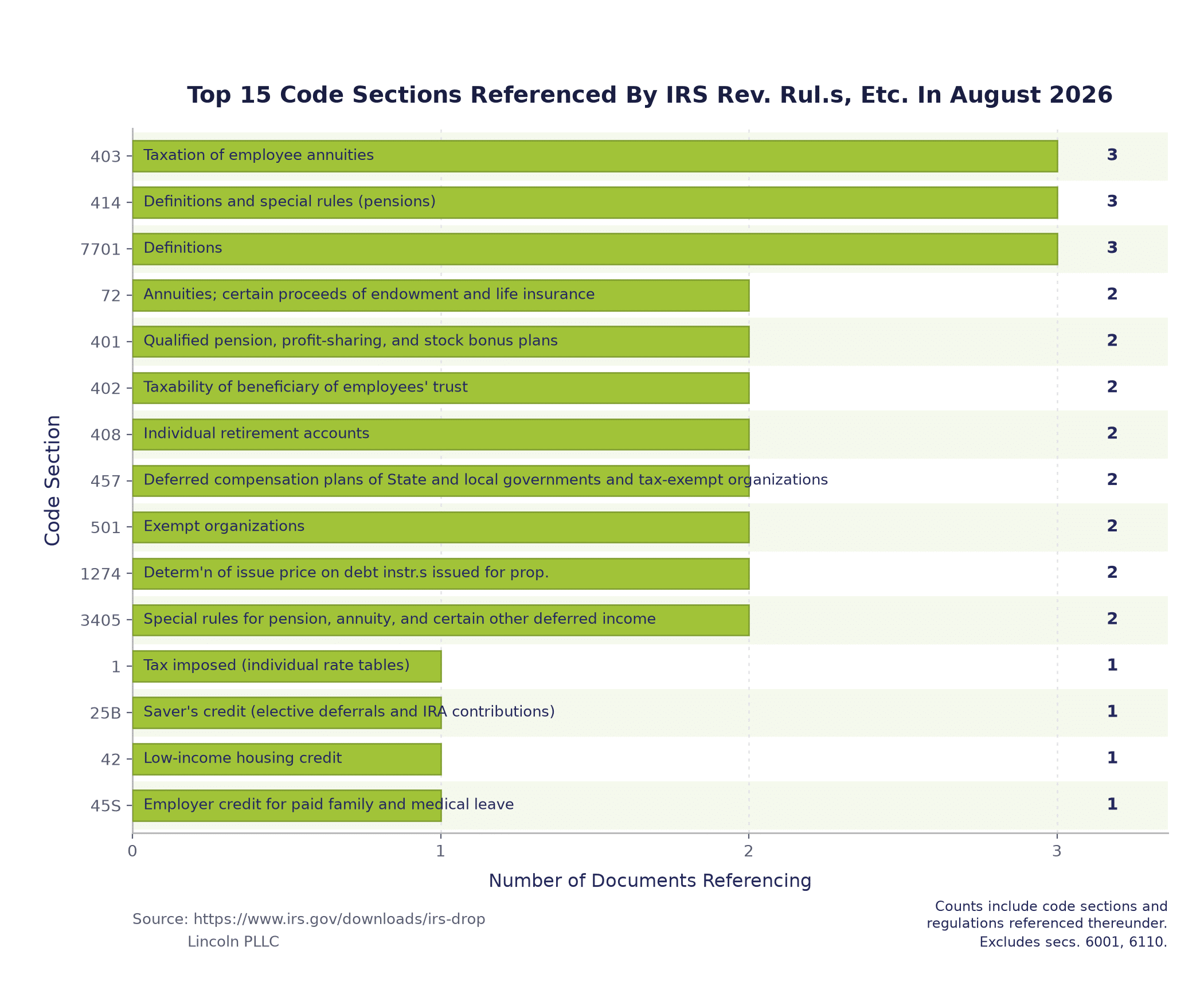
Document Summaries (10 documents)
Revenue Rulings (3)
Rev. Rul. 2026-16 (Aug. 10, 2026)Code sections referenced: § 446, § 481, § 1256, § 7805
Rev. Rul. 2026-16 is a revenue ruling addressing whether ICE Endex, a regulated exchange of the Netherlands, qualifies as a "qualified board or exchange" under § 1256(g)(7)(C). The IRS determines that ICE Endex meets that definition, and therefore that futures contracts and futures contract options traded on ICE Endex are subject to § 1256 mark-to-market treatment, so long as ICE Endex holds a valid Order of Registration under the CFTC foreign board of trade registration system; the ruling applies prospectively to ICE Endex Contracts entered into on or after September 1, 2026, with the accompanying accounting method change made on a cut-off basis for the first taxable year in which a taxpayer holds such contracts. The ruling relies on §§ 1256, 446, 481, and 7805, as well as Treas. Reg. § 1.446-1 and Treas. Reg. § 301.7805-1.
Rev. Rul. 2026-15 (Aug. 21, 2026)Code sections referenced: § 1274, § 6601, § 6603, § 6621, § 6622, § 6654, § 6655
Rev. Rul. 2026-15 is a revenue ruling that establishes the federal tax interest rates on overpayments and underpayments of tax for the calendar quarter beginning October 1, 2026. For that quarter, the overpayment rate is 7 percent (6 percent for corporations), the corporate overpayment rate for amounts exceeding $10,000 is 4.5 percent, the underpayment rate is 7 percent, the large corporate underpayment rate is 9 percent, and the section 6603 deposit rate is 4 percent; the same 7 percent underpayment rate applies to estimated tax underpayments for the fourth calendar quarter of 2026. The ruling relies on sections 1274(d), 6601, 6603(d)(4), 6621(a)(1), 6621(a)(2), 6621(b)(1), 6621(b)(2)(A), 6621(b)(3), 6621(c), 6622, 6654(a)(1), and 6655(a)(1), as well as Treas. Reg. § 301.6621-1, Treas. Reg. § 301.6621-3, Notice 88-59, and Rev. Proc. 95-17.
Rev. Rul. 2026-17 (Aug. 21, 2026)Code sections referenced: § 42, § 280G, § 382, § 467, § 468, § 482, § 483, § 1274, § 1288, § 7520, § 7702, § 7872
Rev. Rul. 2026-17 is a revenue ruling that provides the prescribed federal rates for federal income tax purposes for September 2026. The ruling sets the short-term, mid-term, and long-term AFRs; the adjusted AFRs; the adjusted federal long-term rate and long-term tax-exempt rate for section 382 ownership changes; the appropriate percentages for the low-income housing credit (8.12% for the 70% present-value credit and 3.48% for the 30% present-value credit); and the section 7520 rate of 5.40%. The ruling relies on sections 42, 280G, 382, 467, 468, 482, 483, 1274, 1288, 7520, 7702, and 7872 of the Internal Revenue Code.
Revenue Procedures (1)
Rev. Proc. 2026-30 (Aug. 5, 2026)
Rev. Proc. 2026-30 is a revenue procedure that modifies Rev. Proc. 2026-4 to address how taxpayers must submit requests for letter rulings and nonbank trustee approval letters under the jurisdiction of Employee Plans Rulings and Agreements. Effective September 4, 2026, all such requests must be submitted electronically through www.pay.gov using Form 15662, user fees must be paid through that portal rather than by paper check, and paper submissions mailed to the Service will be returned to the applicant. The document relies on the Paperwork Reduction Act of 1995 (44 U.S.C. §§ 3501–3520) and references Rev. Procs. 87-50, 90-49, 2003-16, 2010-52, 2017-57, 2024-32, and 2026-4, but cites no Internal Revenue Code sections.
Notices (5)
Notice 2026-28 (Aug. 5, 2026)Code sections referenced: § 38, § 45S, § 52, § 280C, § 414, § 3306, § 7701
Notice 2026-28 is an IRS notice that addresses how employers may calculate and claim the section 45S paid family and medical leave credit using the premium method added by section 70304 of the One Big Beautiful Bill Act, including how to identify creditable coverage, allocate blended premiums, and coordinate the premium method with the wage method. The notice concludes that a premium (or portion thereof) qualifies for the credit only to the extent it funds coverage for leave that would be creditable under the wage method, that blended premiums must be allocated between creditable and noncreditable coverage using any reasonable, consistently applied method supported by contemporaneous records, and that an employer may use both methods for different instances of leave but may not claim credit under both methods for the same instance. The notice relies on Code sections 45S, 38(b)(32), 280C(a), 52(a) and (b), 414(b) and (c), 3306(b), and 7701(a)(25), as well as the Fair Labor Standards Act section 3(e) as incorporated by section 45S(d).
Notice 2026-48 (Aug. 7, 2026)Code sections referenced: § 1, § 25B, § 72, § 102, § 103, § 152, § 204, § 219, § 401, § 402, § 402A, § 403, § 404, § 408, § 408A, § 411, § 413, § 414, § 415, § 416, § 457, § 501, § 529A, § 911, § 931, § 933, § 3121, § 3405, § 4974, § 6013, § 6058, § 6402, § 6433, § 7701
Notice 2026-48 is an IRS and Treasury Department notice of intent to issue proposed regulations addressing the operation of the Saver's Match contribution program under Code section 6433, including eligibility, contribution calculations, applicable retirement savings vehicles, payment mechanics, reporting, and the relationship of Saver's Match contributions to the former Saver's Credit. Treasury and the IRS conclude that, for taxable years beginning after December 31, 2026, eligible low- and moderate-income individuals who make qualified retirement savings contributions may receive a matching contribution of up to $1,000 paid directly to an applicable retirement savings vehicle (generally a pre-tax employer plan or traditional IRA), with the matching percentage phased out based on MAGI and filing status, and that the forthcoming proposed regulations will be consistent with the Q&A guidance set out in Section IV of the notice. The principal authorities relied on are Code sections 6433 (as added by section 103 of the SECURE 2.0 Act), 25B, 72(t), 219(e), 402(g)(3), 402A(b), 408(a) and (b), 408A, 401(k), 403(b), 457(b), 414(d) and (e), 415(c), 529A, 1(f)(3), 3405, 6058, and 6402(c)–(f), together with Treas. Reg. § 1.408A-4 and section 103(c)(2) of the SECURE 2.0 Act, Pub. L. 117-328.
Notice 2026-49 (Aug. 12, 2026)Code sections referenced: § 72, § 319, § 324, § 401, § 402, § 403, § 408, § 457, § 501, § 3405
IRS Notice 2026-49 is a guidance notice issued by the Treasury Department and the IRS under section 324 of the SECURE 2.0 Act addressing how to simplify, standardize, facilitate, and expedite the completion of rollovers to eligible retirement plans and trustee-to-trustee transfers from individual retirement plans. The notice proposes optional sample forms and a five-step rollover procedure—emphasizing electronic transfers, encrypted data, and a unique rollover identification number—to reduce participant burden and increase uniformity between distributing and receiving plans, while also identifying additional guidance under consideration, including potential elimination of the paper-check-to-participant method and new safe harbors, but does not currently establish any safe harbor based on use of the sample forms. The notice relies on Code sections 401(a)(31), 402(a), 402(c), 402(e)(6), 403(a), 403(b), 408(a), 408(b), 408(d)(3), 457(b), and 501(a), as well as Treasury Regulations §§ 1.401(a)(31)-1 (Q&A-3, Q&A-4, Q&A-6, and Q&A-14) and Revenue Ruling 2014-9.
Notice 2026-50 (Aug. 14, 2026)Code sections referenced: § 43, § 45Q, § 115, § 6227, § 7701
Notice 2026-50 is an IRS notice that modifies and amplifies Notice 2026-1 to address two questions left open by that prior guidance: whether the existing safe harbor for the § 45Q carbon oxide sequestration credit extends to qualified carbon oxide used as a tertiary injectant in a qualified enhanced oil or natural gas recovery project, and whether taxpayers may rely on the safe harbor to determine amounts securely stored and leaked for purposes of the recapture rules. The notice expands the safe harbor to cover tertiary injectant projects with EPA-approved MRV plans that comply with subpart RR as in effect on December 31, 2025, permits taxpayers to satisfy the recapture determination requirements through that same safe harbor mechanism, and extends the safe harbor's applicability date through December 31 of the calendar year in which Treasury and the IRS publish further interim guidance or proposed regulations addressing § 45Q measurement, reporting, and verification requirements. The notice relies principally on § 45Q, § 43(c)(2), § 6001, § 6227, and regulations §§ 1.45Q-2(h)(5), 1.45Q-3(b)(1) and (2), 1.45Q-3(d), and 1.45Q-5(a) and (c).
Notice 2026-51 (Aug. 21, 2026)Code sections referenced: § 412, § 414, § 417, § 430, § 431, § 433
Notice 2026-51 is an IRS notice that provides updated interest rate figures used to determine minimum funding requirements and minimum present value for qualified pension plans, addressing the corporate bond monthly yield curve, 24-month average segment rates, and 30-year Treasury weighted average rates applicable for August 2026. The notice publishes the July 2026 monthly corporate bond yield curve, spot segment rates of 4.62, 5.62, and 6.51 for the first, second, and third segments respectively, unadjusted 24-month average segment rates of 4.35, 5.28, and 5.96 for August 2026, adjusted segment rates reflecting the 95%–105% corridor for plan years beginning in 2025 and 2026, a 30-year Treasury weighted average rate of 4.59% with a permissible range of 4.13% to 4.82% for plan years beginning in August 2026, and minimum present value segment rates of 4.62, 5.62, and 6.51 for July 2026. The notice relies on §§ 412, 414(y), 417(e)(3), 417(e)(3)(A)(ii)(II), 417(e)(3)(D), 430(h)(2), 430(h)(2)(C)(i)–(iv), 430(h)(2)(D)(ii), 431(c)(6)(A), 431(c)(6)(B), 431(c)(6)(E)(ii)(I), 433(c)(7)(C), and 433(h)(3)(A), together with Treas. Reg. §§ 1.417(e)-1(d)(3) and 1.430(h)(2)-1(c) and (d), and Notice 88-73.
Announcements (1)
Announcement 2026-15 (Aug. 5, 2026)Code sections referenced: § 403
Announcement 2026-15 is an IRS announcement addressing the timeline and procedural requirements for the fourth remedial amendment cycle (Cycle 4) for defined contribution qualified pre-approved plans, including the issuance of opinion letters, the employer adoption deadline, and the opening of the determination letter program. The IRS intends to issue Cycle 4 opinion letters on or about August 31, 2026; adopting employers must adopt a newly approved defined contribution qualified pre-approved plan by September 30, 2028 to fall within Cycle 4; and eligible adopting employers may apply for an individual determination letter during the window beginning October 1, 2026 and ending September 30, 2028. The announcement relies on Rev. Proc. 2023-37, Notice 2024-3, and Rev. Proc. 2026-4, and references section 403(b) of the Code in the context of the broader pre-approved plan system.
In August 2026, the IRS published 78 PLRs and 1 CCA, which included a total of 448 pages.
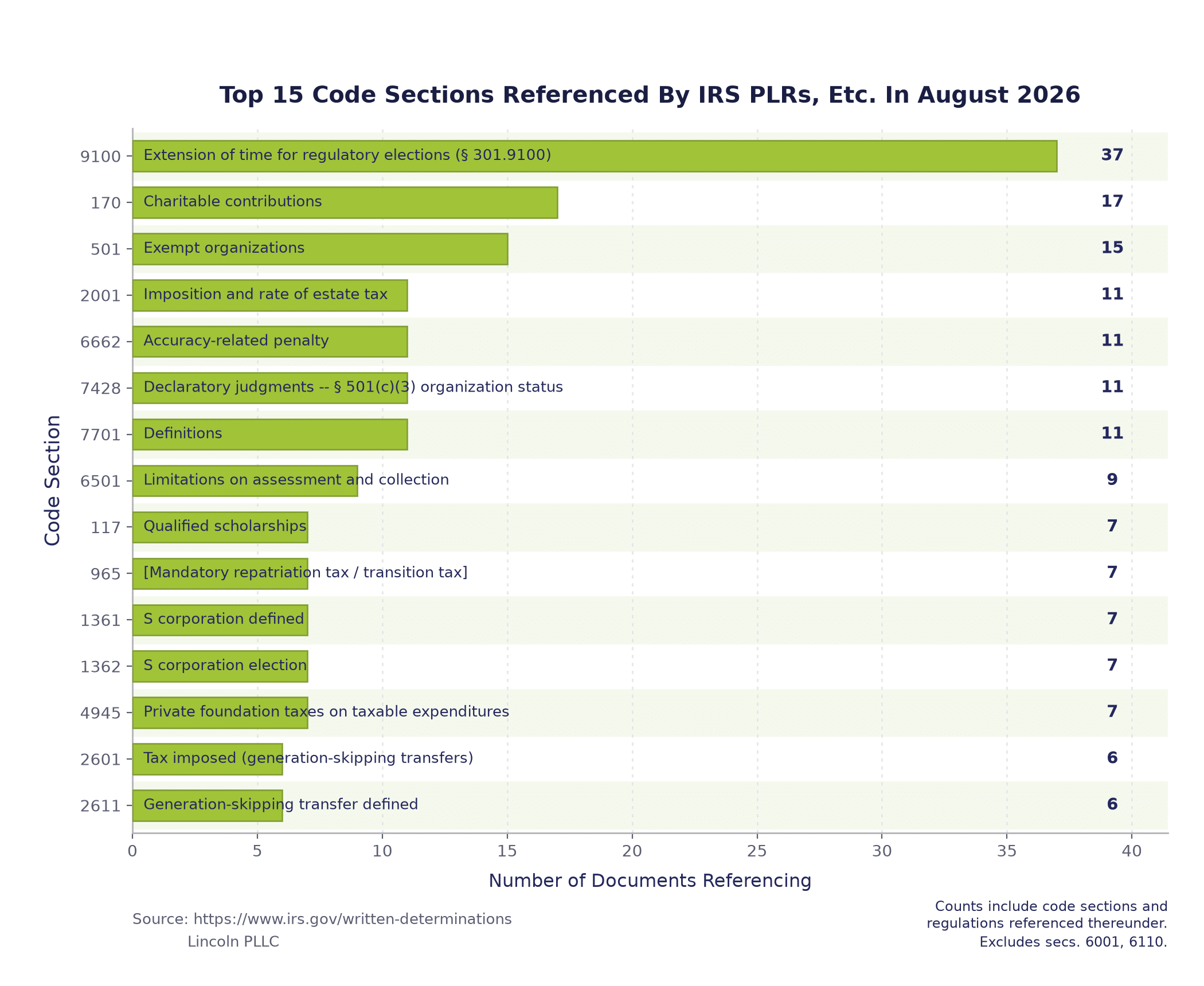
Document Summaries (79 documents)
Private Letter Rulings — § 9100 Relief (37)
Priv. Ltr. Rul. 2026-32-001 (Aug. 7, 2026)Code sections referenced: § 468A, § 6662, § 6664, § 9100
Private Letter Ruling 202632001 is a ruling responding to Taxpayer's request for an extension of time to file a revised schedule of ruling amounts under § 468A(d)(1) for a nuclear decommissioning reserve fund maintained for Unit, following renewal of Unit's operating license, after Taxpayer missed the deadline prescribed by § 1.468A-3(f)(1)(iv) due to delays in receiving an updated decommissioning study from Company E. The IRS granted the extension, concluding that Taxpayer acted reasonably and in good faith because the failure to timely file resulted from intervening events beyond Taxpayer's control and the request was made before the Service discovered the failure, and that granting relief would not prejudice the government's interests because no reduction in aggregate tax liability would result and the relevant taxable years remain open. The ruling relies on §§ 468A(a), 468A(b), and 468A(d)(1) of the Code and §§ 1.468A-1(a), 1.468A-1(b)(1), 1.468A-1(b)(2), 1.468A-2(b)(1), 1.468A-3(f)(1)(i), and 1.468A-3(f)(1)(iv) of the Income Tax Regulations, together with §§ 301.9100-1, 301.9100-2, and 301.9100-3 of the Procedure and Administration Regulations and § 6110(k)(3) of the Code.
Priv. Ltr. Rul. 2026-32-002 (Aug. 7, 2026)Code sections referenced: § 468A, § 1468A, § 9100
Private Letter Ruling 202632002 is a response to Taxpayer's request for a revised schedule of ruling amounts under § 468A(d)(1) for a nuclear decommissioning reserve fund established for Unit, addressing whether Taxpayer's proposed formula-based schedule satisfies the statutory and regulatory requirements. The Service concluded that Taxpayer has a qualifying interest in Unit, that its proposed schedule of ruling amounts is based on reasonable assumptions consistent with Commission's rate order, and accordingly approved a revised schedule providing formula-determined ruling amounts for Year 3 through Year 2 and a fixed annual amount of $i for Year 4 through Year 5. The ruling relies principally on §§ 468A(a), 468A(b), 468A(d)(1)–(3), 468A(h), and 468A-6(a) of the Code, and on Treas. Reg. §§ 1.468A-1(a), 1.468A-1(b)(1)–(2), 1.468A-2(b)(1), 1.468A-2(c)(1), 1.468A-3(a)(1)–(5), 1.468A-3(b)(1), 1.468A-3(c)(1)–(2), 1.468A-3(d)(1), 1.468A-3(e)(1)–(3), 1.468A-3(f)(1), 1.468A-6, and 1.468A-7(a), as well as §§ 301.9100-1 and 301.9100-3.
Priv. Ltr. Rul. 2026-32-003 (Aug. 7, 2026)Code sections referenced: § 468A, § 6662, § 6664, § 9100
Private Letter Ruling 202632003 is a ruling responding to Taxpayer's request for an extension of time to file a revised schedule of ruling amounts for a nuclear decommissioning reserve fund maintained for Unit, which was required following the renewal of Unit's operating license under § 1.468A-3(f)(1)(iv). The IRS granted Taxpayer the extension, concluding that Taxpayer acted reasonably and in good faith because the failure to timely file was caused by intervening events beyond Taxpayer's control—specifically, the delayed completion of an updated decommissioning study by Company E—and that granting relief would not prejudice the interests of the Government. The ruling relies on §§ 468A(a), 468A(b), and 468A(d)(1) of the Code, §§ 1.468A-1(a), 1.468A-1(b)(1), 1.468A-1(b)(2), 1.468A-2(b)(1), and 1.468A-3(f)(1)(i) and (iv) of the Income Tax Regulations, and §§ 301.9100-1, 301.9100-2, and 301.9100-3 of the Procedure and Administration Regulations.
Priv. Ltr. Rul. 2026-32-004 (Aug. 7, 2026)Code sections referenced: § 468A, § 1468A, § 9100
Private Letter Ruling 202632004 is a response to Taxpayer's request for a revised schedule of ruling amounts under § 468A(d)(1) for a nuclear decommissioning reserve fund established for Unit, addressing whether Taxpayer's proposed formula-based schedule satisfies the statutory and regulatory requirements for deductible contributions to a qualified nuclear decommissioning fund. The Service concluded that Taxpayer holds a qualifying interest in Unit, that its proposed schedule is consistent with the applicable Commission rate order and therefore based on reasonable assumptions, and approved both the Formula for determining ruling amounts from Year 3 through Year 2 and a fixed annual funding amount of $i for Year 4 through Year 5. The ruling relies on §§ 468A(a), 468A(b), 468A(d)(1), (2), and (3), 468A(h), and 1.468A-1(a), (b)(1) and (b)(2), 1.468A-2(b)(1), (c)(1), 1.468A-3(a)(1)–(5), (b)(1), (c)(1), (c)(2)(i)(A)–(C), (c)(2)(ii), (d)(1), (e)(1)(v), (e)(2), (e)(3), (f)(1)(i), (f)(1)(ii)(B), 1.468A-6(a), 1.468A-7(a), and §§ 301.9100-1 and 301.9100-3.
Priv. Ltr. Rul. 2026-32-005 (Aug. 7, 2026)Code sections referenced: § 734, § 743, § 754, § 6031, § 6227, § 9100
Private Letter Ruling 202632005 is a ruling responding to X's request for an extension of time to file a § 754 election after X inadvertently failed to make the election for Year, the taxable year in which A purchased an a% interest in X from existing partners. The IRS granted X a 120-day extension from the date of the letter to make the § 754 election effective for Year and thereafter, conditioned on X filing amended returns reflecting the § 734(b) and § 743(b) basis adjustments that would have applied had the election been timely made, partners adjusting their outside bases accordingly, and X complying with § 6227(b) if an administrative adjustment request is required. The ruling relies on §§ 754, 734(b), 743(b), and 6227(b) of the Code, and §§ 301.9100-1, 301.9100-2, 301.9100-3, 1.754-1(b), and 1.6031-1(e) of the regulations.
Priv. Ltr. Rul. 2026-32-006 (Aug. 7, 2026)Code sections referenced: § 1502, § 6501, § 6662, § 9100
Private Letter Ruling 202632006 is a ruling responding to Parent's request for an extension of time to file an election under §1.1502-75(a)(1) to file a consolidated federal income tax return with Parent as the common parent for the taxable year ending on Date 1. The IRS granted Parent a 75-day extension from the date of the ruling to file the Election by filing a consolidated return and attaching Form 1122 for each subsidiary, conditioned on the Parent Group's aggregate tax liability being no lower for all affected years than it would have been had the Election been timely made, and on the statute of limitations remaining open for the taxable year ending on Date 1 and all subsequent years. The ruling relied on Code sections 6501(a), 6662, and 6110(k)(3), and on Treas. Reg. §§301.9100-1, 301.9100-2, 301.9100-3, and 1.1502-75(a)(1).
Priv. Ltr. Rul. 2026-32-008 (Aug. 7, 2026)Code sections referenced: § 965, § 7701, § 9100
Private Letter Ruling 202632008 is a letter ruling responding to Company's request for an extension of time to file a Form 8832 electing disregarded-entity classification for federal tax purposes, where Company, a foreign entity formed under the laws of Country, failed to timely file the election effective Date. The IRS granted Company a 120-day extension from the date of the letter to file Form 8832 electing to be disregarded as an entity separate from its owner effective Date, having found that Company acted reasonably and in good faith and that granting relief would not prejudice the Government's interests. The ruling relies on §§ 301.7701-2, 301.7701-3, 301.9100-1, 301.9100-2, and 301.9100-3 of the Procedure and Administration Regulations, with an additional caveat under § 1.965-4(c)(2) of the Income Tax Regulations and § 965 of the Code regarding the treatment of the election for purposes of determining § 965 elements of United States shareholders.
Priv. Ltr. Rul. 2026-32-012 (Aug. 7, 2026)Code sections referenced: § 965, § 7701, § 9100
Private Letter Ruling 202632012 addresses a request by Company, a foreign eligible entity formed under the laws of Territory on Date 1, for an extension of time to file a Form 8832 electing to be treated as an entity disregarded from its owner for federal tax purposes effective Date 2. The IRS granted Company a 120-day extension from the date of the ruling to file Form 8832, conditioned on Company and its owner filing all required federal income tax and information returns consistent with the relief within the same period, and noting that the disregarded-entity election is disregarded for purposes of any § 965 elements if the election would otherwise alter those amounts. The ruling relies on §§ 301.7701-2, 301.7701-3, 301.9100-1, 301.9100-2, 301.9100-3, 965, and 6110(k)(3).
Priv. Ltr. Rul. 2026-32-013 (Aug. 7, 2026)Code sections referenced: § 2001, § 2010, § 6018, § 9100
Private Letter Ruling 202632013 is a ruling responding to a request by Decedent's estate for an extension of time to make a portability election under § 2010(c)(5)(A), allowing Spouse to utilize Decedent's deceased spousal unused exclusion (DSUE) amount after an estate tax return was not timely filed. The IRS concluded that Decedent's estate acted reasonably and in good faith and that granting relief would not prejudice the government's interests, and accordingly granted a 120-day extension from the date of the letter to file a complete and properly prepared Form 706 to make the portability election, subject to being deemed null and void if Decedent's estate is later determined to have been required to file under § 6018(a). The ruling relies on §§ 2001, 2010(c)(1)–(5)(A), 6018(a), 20.2010-2(a)(1) and (a)(2), 20.2010-3(c)(1) and (d), 301.9100-1(c), 301.9100-2, and 301.9100-3, as well as the Tax Relief, Unemployment Insurance Reauthorization, and Job Creation Act of 2010, Pub. L. No. 111-312, § 303.
Priv. Ltr. Rul. 2026-32-014 (Aug. 7, 2026)Code sections referenced: § 856, § 6501, § 6662, § 9100
Private Letter Ruling 202632014 is a ruling responding to a request by Taxpayer and Subsidiary for an extension of time to jointly file a taxable REIT subsidiary election on Form 8875, addressing whether the failure to timely make that election—caused by Accounting Firm's unawareness of Taxpayer's indirect acquisition of Subsidiary following a post-closing structure chart that omitted Subsidiary by name—qualifies for relief. The IRS concluded that Taxpayer and Subsidiary acted reasonably and in good faith and that granting relief would not prejudice the Government's interests, and accordingly granted a 90-calendar-day extension from the date of the ruling to file Form 8875 electing to treat Subsidiary as a TRS of Taxpayer effective Date 7. The ruling relies on Code section 856(l) and Treas. Reg. sections 301.9100-1, 301.9100-2, and 301.9100-3, as well as Code section 6501(a), Code section 6662, Code section 6110(k)(3), and Announcement 2001-17, 2001-1 C.B. 716.
Priv. Ltr. Rul. 2026-32-015 (Aug. 7, 2026)Code sections referenced: § 965, § 7701, § 9100
Private Letter Ruling 202632015 is a letter ruling responding to X's request for an extension of time to file a Form 8832 electing partnership classification for federal tax purposes, after X failed to make the election by the applicable deadline. The IRS concluded that X satisfied the requirements for discretionary relief and granted X a 120-day extension from the date of the ruling to file Form 8832 electing partnership status effective Date, subject to the condition that X and its owners file all required federal income tax and information returns consistent with the relief within that same period. The ruling relies on §§ 301.7701-2, 301.7701-3, 301.9100-1, 301.9100-2, and 301.9100-3 of the Procedure and Administration Regulations, and notes the applicability of § 1.965-4(c)(2) and § 6110(k)(3) of the Code.
Priv. Ltr. Rul. 2026-32-016 (Aug. 7, 2026)Code sections referenced: § 965, § 7701, § 9100
Private Letter Ruling 202632016 is a ruling responding to a request by X, a foreign entity, for an extension of time to file Form 8832 electing to be classified as an entity disregarded as separate from its owner for federal tax purposes effective Date. The IRS concluded that X satisfied the applicable requirements and granted X a 120-day extension from the date of the letter to file Form 8832, subject to the condition that X and its owners file all required federal income tax and information returns consistent with the relief granted within that same period. The ruling relies on §§ 301.7701-2, 301.7701-3, 301.9100-1, 301.9100-2, 301.9100-3, 965, 1.965-4(c)(2), and 6110(k)(3).
Priv. Ltr. Rul. 2026-32-017 (Aug. 7, 2026)Code sections referenced: § 7701, § 9100
Private Letter Ruling 202632017 addresses requests by X and Y—foreign eligible entities formed under the laws of Country 1 and Country 2, respectively—for extensions of time to file Form 8832 electing disregarded-entity classification effective Date 1 and Date 2, after each entity failed to make a timely election. The IRS granted both X and Y a 120-day extension from the date of the ruling to file Form 8832, conditioned on X, Y, and their owners filing all required federal income tax and information returns, including Forms 8858, for all open years consistent with timely elections having been made. The ruling relies on §§ 301.7701-2, 301.7701-3, 301.9100-1, 301.9100-2, and 301.9100-3 of the Procedure and Administration Regulations, and § 6110(k)(3) of the Internal Revenue Code.
Priv. Ltr. Rul. 2026-32-019 (Aug. 7, 2026)Code sections referenced: § 301, § 856, § 6501, § 6662, § 9100
Private Letter Ruling 202632019 is a ruling responding to a request by Taxpayer and Subsidiary for an extension of time to jointly elect to treat Subsidiary as a taxable REIT subsidiary of Taxpayer, effective Date 3, after Accounting Firm missed the filing deadline due to a scheduling conflict that delayed communication of the relevant facts. The IRS concluded that Taxpayer and Subsidiary satisfied the requirements for a reasonable extension of time, granting them 90 calendar days from the date of the letter to file Form 8875 with an effective date of Date 3. The ruling relies on Code sections 856(l), 6501(a), and 6662, as well as Treas. Reg. sections 301.9100-1, 301.9100-2, and 301.9100-3, and Announcement 2001-17, 2001-1 C.B. 716.
Priv. Ltr. Rul. 2026-32-020 (Aug. 7, 2026)Code sections referenced: § 856, § 6501, § 6662, § 9100
Private Letter Ruling 202632020 is a ruling responding to a request by Taxpayer and Subsidiary for an extension of time to make a taxable REIT subsidiary election under § 856(l), where the election was not timely filed due to employee turnover and resulting communication failures between Limited Partnership and Entity that caused the parties to be unaware that construction of the Project had been completed and the asset had become operational. The IRS granted the extension, concluding that Taxpayer and Subsidiary acted reasonably and in good faith and that granting relief would not prejudice the interests of the Government, so the Form 8875 filed on Date 8 will be treated as timely filed with an effective date of Date 1. The ruling relies on § 856(l), §§ 301.9100-1 and 301.9100-3 of the Procedure and Administration Regulations, § 6501(a), § 6662, § 6110(k)(3), and Announcement 2001-17, 2001-8 C.B. 716.
Priv. Ltr. Rul. 2026-32-021 (Aug. 7, 2026)Code sections referenced: § 856, § 6501, § 6662, § 9100
Private Letter Ruling 202632021 is a ruling responding to a request by Taxpayer and Subsidiary 1 for an extension of time to jointly elect to treat Subsidiary 1 as a taxable REIT subsidiary of Taxpayer effective Date 1, where the election was not timely made because Accounting Firm mistakenly believed Taxpayer held its interest in Subsidiary 1 through a partnership and therefore erroneously recommended a structure relying on the temporary investment of new capital rule rather than a TRS election. The IRS concluded that Taxpayer and Subsidiary 1 acted reasonably and in good faith by reasonably relying on a qualified tax professional who failed to advise making the election, that granting relief would not prejudice the Government, and accordingly granted a 90-calendar-day extension from the date of the letter to file Form 8875 electing TRS status for Subsidiary 1 effective Date 1. The ruling relies on Code sections 856(l), 856(c)(2), 856(c)(3), 856(c)(4)(A), 856(c)(5)(B), and 6501(a), as well as Treas. Reg. §§ 301.9100-1 and 301.9100-3, and Announcement 2001-17, 2001-1 C.B. 716.
Priv. Ltr. Rul. 2026-33-001 (Aug. 14, 2026)Code sections referenced: § 7701, § 9100
Private Letter Ruling 202633001 addresses requests by W, X, Y, and Z — each a professional limited liability company that inadvertently failed to timely file Form 8832 — for extensions of time to elect association taxation as corporations effective Date. The IRS granted each entity a 120-day extension from the date of the ruling to file Form 8832, conditioned on W, X, Y, and Z and their owners also filing, within that same 120-day period, any income tax or information returns required under the Code consistent with the requested relief being effective Date. The ruling relies on §§ 301.7701-2, 301.7701-3(a), (b)(1), (c)(1)(i), and (c)(1)(iii), 301.9100-1, 301.9100-2, and 301.9100-3, as well as § 6110(k)(3).
Priv. Ltr. Rul. 2026-33-003 (Aug. 14, 2026)Code sections referenced: § 965, § 7701, § 9100, § 9654
Private Letter Ruling 202633003 addresses a request by Entity 1 and Entity 2 — two foreign entities formed under the laws of Country 1 and Country 2, respectively — for an extension of time to file Form 8832 entity classification elections after failing to make timely filings. The IRS granted each entity a 120-day extension from the date of the letter to elect partnership status (Entity 1, effective Date 1) and disregarded entity status (Entity 2, effective Date 2), conditioned on each entity and its owners filing all required federal income tax and information returns consistent with the relief within the same 120-day period. The ruling relies on §§ 301.7701-3, 301.9100-1, and 301.9100-3, and notes the potential application of § 965 and § 1.965-4(c)(2) to the elections.
Priv. Ltr. Rul. 2026-33-004 (Aug. 14, 2026)Code sections referenced: § 2001, § 2044, § 2055, § 2056, § 2101, § 2207A, § 2519, § 2522, § 2601, § 2602, § 2611, § 2631, § 2632, § 2641, § 2642, § 2652, § 9100
Private Letter Ruling 202633004 is a ruling responding to a request for an extension of time to make a QTIP election and a reverse QTIP election that Accountant failed to make on Decedent's timely filed Form 706, having omitted GST Exempt Marital Trust and GST Non-Exempt Marital Trust from Schedule M. The IRS granted the executors of Decedent's estate a 120-day extension from the date of the ruling to make a QTIP election under § 2056(b)(7) with respect to GST Exempt Marital Trust and GST Non-Exempt Marital Trust, and a reverse QTIP election under § 2652(a)(3) with respect to GST Exempt Marital Trust, on a supplemental Form 706, concluding that the requirements of § 301.9100-3 were satisfied because Decedent's estate reasonably relied on Accountant, a qualified tax professional, who failed to make the elections. The ruling relies on §§ 2001, 2056(a), 2056(b)(7), 2601, 2602, 2611, 2631, 2632, 2641, 2642, 2652(a)(1), 2652(a)(3), 6110(k)(3), Treas. Reg. §§ 20.2056(b)-7(b)(4)(i), 26.2652-1(a)(3), 26.2652-2(a) and (b), 301.9100-1(c), and 301.9100-3.
Priv. Ltr. Rul. 2026-33-006 (Aug. 14, 2026)Code sections referenced: § 2001, § 2010, § 6018, § 9100
Private Letter Ruling 202633006 is a ruling responding to a request by Decedent's estate for an extension of time to make a portability election under § 2010(c)(5)(A), specifically whether the estate qualified for relief after failing to timely file a Form 706 to allow Spouse to utilize Decedent's deceased spousal unused exclusion (DSUE) amount. The IRS granted a 120-day extension from the date of the letter for Decedent's estate to file a complete and properly prepared Form 706 to elect portability, concluding that the estate acted reasonably and in good faith and that granting relief would not prejudice the interests of the government, subject to the condition that the grant becomes null and void if it is later determined that the estate was required to file under § 6018(a). The ruling relies on §§ 2001(a), 2001(c), 2010(a), 2010(c)(1) through (c)(5)(A), 6018(a), 6110(k)(3), 301.9100-1(c), 301.9100-3, 20.2010-2(a)(1), 20.2010-2(a)(2), and 20.2010-3(c)(1) and (d), as well as the Tax Relief, Unemployment Insurance Reauthorization, and Job Creation Act of 2010, Pub. L. No. 111-312, § 303.
Priv. Ltr. Rul. 2026-33-007 (Aug. 14, 2026)Code sections referenced: § 1400Z, § 6662, § 9100
Private Letter Ruling 202633007 is a ruling responding to Taxpayer's request for an extension of time to make a late regulatory election to defer eligible capital gain invested in a qualified opportunity fund (QOF) by attaching Form 8949 to Taxpayer's Year 1 federal income tax return. The IRS concluded that Taxpayer acted reasonably and in good faith and that granting relief would not prejudice the interests of the Government, and accordingly treated Taxpayer's late-filed Form 8949 for Year 1 as timely filed. The ruling relies on sections 1400Z-2(a)(1)(A), 1400Z-2(d), and Treasury Regulations §§ 1.1400Z2(a)-1(a)(2), 1.1400Z2(a)-1(d)(1), 301.9100-1, 301.9100-3(a), 301.9100-3(b)(1), 301.9100-3(b)(3), and 301.9100-3(c)(1).
Priv. Ltr. Rul. 2026-33-008 (Aug. 14, 2026)Code sections referenced: § 1502, § 6501, § 6662, § 9100
Private Letter Ruling 202633008 addresses whether Parent is entitled to an extension of time to file a consolidated federal income tax return election for the tax year ending on Date 1, after Parent Group failed to make the election by the applicable due date because a qualified tax professional failed to make or advise Parent to make the election. The IRS granted Parent a 75-day extension from the date of the ruling to file the election by filing a consolidated return with Parent as common parent and attaching a Form 1122 for each subsidiary that was a member of Parent Group for the tax year ending on Date 1, conditioned on the Parent Group's aggregate tax liability being no lower for all affected years than it would have been had the election been timely made. The ruling relies on Code sections 6501(a), 6662, 6110(k)(3), and Treasury Regulations §§ 301.9100-1, 301.9100-2, 301.9100-3, and 1.1502-75(a)(1).
Priv. Ltr. Rul. 2026-34-003 (Aug. 21, 2026)Code sections referenced: § 441, § 442, § 444, § 706, § 9100
Private Letter Ruling 202634003 is a ruling responding to Taxpayer's request for an extension of time to make a late regulatory election to file Form 1128 to adopt a new taxable year ending on Date 2, effective for Year 1, after Advisor failed to timely file the form or a return extension upon learning of the mandatory year-change requirement triggered by the death of Taxpayer's majority owner. The IRS concluded that Taxpayer acted reasonably and in good faith by relying on a qualified tax professional and that granting relief would not prejudice the interests of the Government, and accordingly will treat Taxpayer's Form 1128 as timely filed. The ruling relies on Code sections 441(a), 441(b), 442, 706(b)(1)(B)(i), and 706(b)(4)(A)(i), together with Treas. Reg. §§ 301.9100-1 through 301.9100-3 and Rev. Proc. 2006-46.
Priv. Ltr. Rul. 2026-34-004 (Aug. 21, 2026)Code sections referenced: § 42, § 48, § 142, § 9100
Private Letter Ruling 202634004 is a ruling responding to Taxpayer's request for an extension of time to make the average income minimum set-aside election under section 42(g)(1)(C), which Taxpayer inadvertently omitted when filing Form 8609 for a multi-building housing project placed in service in Year. The IRS concluded that Taxpayer acted reasonably and in good faith and that granting relief would not prejudice the government's interests, and accordingly granted Taxpayer 120 days from the date of the letter to file amended Forms 8609 making the section 42(g)(1)(C) elections for the Project for Year. The ruling relies on Code sections 42(g)(1), 42(g)(3), 42(l)(1), and 6110(k)(3), and Regulations sections 1.42-1(h), 301.9100-1, 301.9100-1(b), 301.9100-1(c), 301.9100-2, 301.9100-3, 301.9100-3(a), and 301.9100-7T(b).
Priv. Ltr. Rul. 2026-34-005 (Aug. 21, 2026)Code sections referenced: § 7701, § 9100
Private Letter Ruling 202634005 is a ruling responding to X's request for an extension of time to file a Form 8832 entity classification election, addressing whether X demonstrated the reasonable-and-good-faith standard required for late-election relief. The IRS granted X a 120-day extension from the date of the letter to file Form 8832 electing association status taxable as a corporation effective Date 1, conditioned on X and its owners filing all required returns for all open years consistent with the requested relief within that same 120-day period. The ruling relies on §§ 301.7701-2, 301.7701-3, 301.9100-1, 301.9100-2, and 301.9100-3 of the Procedure and Administration Regulations, as well as Code § 6110(k)(3).
Priv. Ltr. Rul. 2026-34-007 (Aug. 21, 2026)Code sections referenced: § 2001, § 2010, § 6018, § 9100
Private Letter Ruling 202634007 is a ruling responding to Decedent's estate's request for an extension of time to make a portability election under § 2010(c)(5)(A), specifically whether the estate could receive relief for its failure to timely file an estate tax return electing to allow Spouse to utilize Decedent's deceased spousal unused exclusion (DSUE) amount. The IRS granted Decedent's estate a 120-day extension from the date of the letter to file a complete and properly prepared Form 706 electing portability, concluding that the estate acted reasonably and in good faith and that granting relief would not prejudice the interests of the government, with the caveat that the extension is null and void if Decedent's estate is later determined to be required to file under § 6018(a). The ruling relies principally on §§ 2001(a), 2010(a), 2010(c)(1) through (c)(5)(A), 6018(a), 301.9100-1(c), 301.9100-3, 20.2010-2(a)(1), and 20.2010-3(c)(1) and (d).
Priv. Ltr. Rul. 2026-34-008 (Aug. 21, 2026)Code sections referenced: § 2001, § 2010, § 6018, § 9100
Private Letter Ruling 202634008 is a ruling responding to Decedent's estate's request for an extension of time to make a portability election under § 2010(c)(5)(A), specifically whether the estate qualified for relief after failing to timely file an estate tax return to preserve Spouse's right to use Decedent's deceased spousal unused exclusion (DSUE) amount. The IRS granted Decedent's estate a 120-day extension from the date of the letter to file a complete and properly prepared Form 706 to make the portability election, conditioned on the representation that the estate is not required to file under § 6018(a) based on the value of the gross estate and adjusted taxable gifts, and subject to the caveat that the extension is null and void if that filing requirement is later determined to apply. The ruling relies on §§ 2001(a), 2010(a), 2010(c)(1) through (c)(5)(A), 6018(a), 301.9100-1(c), 301.9100-3, 20.2010-2(a)(1), 20.2010-2(a)(2), and 20.2010-3(c)(1) and (d), as well as the Tax Relief, Unemployment Insurance Reauthorization, and Job Creation Act of 2010, Pub. L. No. 111-312, § 303.
Priv. Ltr. Rul. 2026-34-009 (Aug. 21, 2026)Code sections referenced: § 965, § 7701, § 9100, § 9654
Private Letter Ruling 202634009 addresses a request by X, a foreign entity formed on Date under the laws of Country, for an extension of time to file Form 8832 electing disregarded entity status for federal tax purposes after X inadvertently failed to make the election by the applicable deadline. The IRS granted X a 120-day extension from the date of the ruling to file a properly executed Form 8832, effective Date, conditioned on X's owners timely filing all required federal income tax and information returns consistent with the relief granted. The ruling relies on §§ 301.7701-2, 301.7701-3, 301.9100-1, 301.9100-2, and 301.9100-3 of the Procedure and Administration Regulations, and notes the applicability of § 965 and § 1.965-4(c)(2) to the classification election.
Priv. Ltr. Rul. 2026-34-012 (Aug. 21, 2026)Code sections referenced: § 6226, § 6241, § 9100
A Chief Counsel Advice memorandum addresses whether a BBA partnership's push-out election package was properly rejected and whether the taxpayer is entitled to section 9100 relief from the resulting missed regulatory deadline. Counsel concluded that the push-out package was properly rejected because the Forms 8985 and 8986 were submitted in an outdated format and in a non-compliant electronic format, and because Part IV of the Forms 8986 failed to include four required items; Counsel further concluded that section 9100 relief is unavailable because a regulatory alternative remedy forecloses it, the taxpayer likely cannot satisfy the reasonable-action-and-good-faith standard, and the corrected package was submitted beyond the maximum six-month extension period, though Counsel noted the IRS retains discretion to accept further corrections since the regulations impose no deadline for receipt of a corrected statement. The memorandum relies on Code sections 6226, 6241(10), and the section 9100 framework, together with Treasury Regulations 301.6226-2(b), (c), (d)(3), and (e)(1)–(4), 301.6226-3(e)(3), 301.9100-1(d)(2), 301.9100-3(b), and 301.9100(c).
Priv. Ltr. Rul. 2026-35-002 (Aug. 28, 2026)Code sections referenced: § 168, § 446, § 743, § 6227, § 9100
Private Letter Ruling 202635002 is a letter ruling responding to Taxpayer's request for an extension of time to make the election under § 168(k) not to claim the additional first-year depreciation deduction for all classes of qualified property placed in service during Taxable Year 1, where Advisor timely filed the return without the bonus depreciation but inadvertently omitted the required election statement. The IRS concluded that Taxpayer acted reasonably and in good faith by relying on Advisor, a qualified tax professional, and that granting relief would not prejudice the government's interests, and accordingly granted Taxpayer a 60-calendar-day extension from the date of the ruling to make the election by filing an amended Form 1065 for Taxable Year 1 with the statement required by § 1.168(k)-2(f)(1)(iii) attached. The ruling relies on §§ 168(k)(1), (2), (6), and (7), Treas. Reg. §§ 1.168(k)-2(f)(1)(i), (ii), and (iii), 301.9100-1, 301.9100-2, and 301.9100-3, § 6227, and Rev. Proc. 2026-1.
Priv. Ltr. Rul. 2026-35-003 (Aug. 28, 2026)Code sections referenced: § 42, § 48, § 142, § 9100
Private Letter Ruling 202635003 is a ruling issued by the IRS Office of Associate Chief Counsel (Energy, Credits, & Excise Tax) addressing whether Taxpayer is entitled to an extension of time to make the average income minimum set-aside election under section 42(g)(1)(C) for a low-income housing project, after Taxpayer inadvertently omitted that election from the Form 8609 filed for a building placed in service in Year 1 with a credit period beginning in Year 2. The IRS granted Taxpayer a 120-day extension from the date of the letter to file an amended Form 8609 making the section 42(g)(1)(C) election with the IRS Philadelphia campus, concluding that the requirements for discretionary relief were satisfied because Taxpayer acted reasonably and in good faith and granting relief would not prejudice the government's interests. The ruling relies on Code sections 42(g)(1), 42(g)(3), 42(l)(1), and 6110(k)(3), along with Treas. Reg. §§ 301.9100-1, 301.9100-2, and 301.9100-3, Temp. Treas. Reg. § 301.9100-7T(b), and Treas. Reg. § 1.42-1(h).
Priv. Ltr. Rul. 2026-35-006 (Aug. 28, 2026)Code sections referenced: § 565, § 856, § 857, § 858, § 4981, § 6501, § 6662, § 9100
Private Letter Ruling 202635006 is a ruling responding to a REIT's request for an extension of time to make an election under section 858(a) to treat a dividend paid in Year 2 as having been paid in Year 1, where the election was not timely made because Company's tax return preparer erroneously reported the dividend on the wrong line of Schedule A of Form 1120-REIT rather than making the required election. The IRS concluded that Company acted reasonably and in good faith by reasonably relying on a qualified tax professional who failed to make the election, that the grant of relief will not prejudice the interests of the Government, and accordingly granted Company 60 calendar days from the date of the ruling to make the section 858(a) election for Year 1. The ruling relies on sections 858(a), 858(b), 858(c), 857(b)(9), 857(b)(3)(A), 856–859, 565, 4981, 6501(a), 6662, and 6110(k)(3) of the Code, together with sections 1.858-1(b) of the Income Tax Regulations and sections 301.9100-1(b), 301.9100-1(c), 301.9100-2, and 301.9100-3(a) through (e) of the Procedure and Administration Regulations.
Priv. Ltr. Rul. 2026-35-008 (Aug. 28, 2026)Code sections referenced: § 2001, § 2056, § 9100
Private Letter Ruling 202635008 is a letter ruling responding to a request by Decedent's estate for an extension of time to make a qualified terminable interest property (QTIP) election under § 2056(b)(7), where the executor had timely filed Form 706 but mistakenly reported the Marital Trust property on Part B of Schedule M as "all other property" rather than identifying it as QTIP property on Part A, thereby failing to make a valid election. The IRS concluded that the requirements of § 301.9100-3 were satisfied because the estate reasonably relied on a qualified tax professional who failed to make the election, and accordingly granted Decedent's estate a 120-day extension from the date of the letter to make the QTIP election on a supplemental Form 706. The ruling relies on §§ 2001(a), 2056(a), 2056(b)(1), 2056(b)(7)(A), 2056(b)(7)(B)(i), (ii), and (v), § 20.2056(b)-7(b)(4)(i) of the Estate Tax Regulations, and §§ 301.9100-1(c) and 301.9100-3 (including § 301.9100-3(b)(1)(v)) of the Procedure and Administration Regulations.
Priv. Ltr. Rul. 2026-35-010 (Aug. 28, 2026)Code sections referenced: § 168, § 174, § 263A, § 446, § 9100
Private Letter Ruling 202635010 addresses a request by Taxpayer, through its representative CPA, for an extension of time to file the original copies of two Forms 3115 seeking automatic consent to change accounting methods under §§ 168, 174, and 263A, after CPA filed Taxpayer's Form 1120-S and the Forms 3115 one day after the extended due date for Year 1. The IRS concluded that Taxpayer acted reasonably and in good faith and that granting relief would not prejudice the Government, and accordingly granted Taxpayer 45 calendar days from the date of the ruling to file the two original Forms 3115 with an amended federal income tax return for Year 1. The ruling relies on §§ 301.9100-1 and 301.9100-3 of the Procedure and Administration Regulations, § 446(e), and Rev. Proc. 2015-13 and Rev. Proc. 2024-23.
Priv. Ltr. Rul. 2026-35-011 (Aug. 28, 2026)Code sections referenced: § 734, § 743, § 754, § 6031, § 6227, § 9100
Private Letter Ruling 202635011 is a ruling responding to X's request for an extension of time to file a § 754 election that X inadvertently failed to make with its partnership return for the taxable year ended Date 3, following the death of partner A on Date 2. The IRS granted X a 120-day extension from the date of the letter to make the § 754 election, conditioned on X filing an amended return or AAR reflecting the § 734(b) and § 743(b) basis adjustments that would have applied had the election been timely made, and on X's partners adjusting the bases of their partnership interests accordingly. The ruling relies on §§ 754, 734, 743, 6227(b), and 6110(k)(3) of the Code, and on §§ 301.9100-1, 301.9100-2, 301.9100-3, and 1.754-1(b)(1) of the regulations.
Priv. Ltr. Rul. 2026-35-012 (Aug. 28, 2026)Code sections referenced: § 2001, § 2010, § 6018, § 9100
Private Letter Ruling 202635012 is a ruling responding to a request by Decedent's estate for an extension of time to make a portability election under § 2010(c)(5)(A), allowing Spouse to utilize Decedent's deceased spousal unused exclusion (DSUE) amount, after an estate tax return was not timely filed because the estate was not otherwise required to file under § 6018(a). The IRS granted a 120-day extension from the date of the letter in which to file a complete and properly prepared Form 706 with the Kansas City Service Center, conditioned on the estate's representations satisfying the reasonable-and-good-faith and no-prejudice-to-the-government standards, and subject to becoming null and void if it is later determined that the estate was in fact required to file under § 6018(a). The ruling relies principally on §§ 2001, 2010(c)(2)–(5), 6018(a), 301.9100-1(c), 301.9100-3, and 20.2010-2(a)(1) and (2) of the Estate Tax Regulations, as well as Pub. L. No. 111-312, § 303.
Priv. Ltr. Rul. 2026-35-013 (Aug. 28, 2026)Code sections referenced: § 301, § 1502, § 1504, § 6501, § 6662, § 6664, § 7701, § 9100
Private Letter Ruling 202635013 addresses a request by Parent, a state LLC that elected corporate classification, for an extension of time to make a consolidated return election under Treas. Reg. § 1.1502-75(a)(1) for Taxable Year 2, after a miscommunication among management, legal counsel, and return preparers caused Parent to be erroneously reported as a disregarded entity, resulting in a consolidated return being filed with Buyer rather than Parent as the common parent. The IRS granted Parent a 75-day extension from the date of the ruling to make the consolidated return election by filing Form 1120 with Parent as common parent and attaching Form 1122 for each includible subsidiary, finding that Parent acted reasonably and in good faith, satisfied all applicable requirements, and that granting relief would not prejudice the government's interests. The ruling relies on Code sections 1502, 1504, and 6501(a), and Treas. Reg. §§ 1.1502-75(a)(1), 1.1502-75(b)(1), 1.1502-75(h)(1) and (h)(2), 301.7701-3, 301.9100-1, 301.9100-3, 1.6664-2(c)(3), and section 6110(k)(3).
Private Letter Rulings — Other (41)
Priv. Ltr. Rul. 2026-32-007 (Aug. 7, 2026)Code sections referenced: § 61, § 1001, § 1011, § 1015, § 1223, § 1433, § 2001, § 2041, § 2501, § 2511, § 2512, § 2514, § 2601, § 2611, § 2642, § 2651, § 2654
Private Letter Ruling 202632007 is a ruling issued in response to a request concerning the GST, gift, and income tax consequences of a proposed division of Family Trust—an irrevocable trust established before September 25, 1985—into four Divided Trusts along family lines, accompanied by certain administrative modifications. The IRS ruled that the division and modification will not cause Family Trust or the Divided Trusts to lose GST-exempt status or become subject to GST tax, will not cause any beneficiary to have made a taxable gift, will not cause recognition of ordinary income, loss, or capital gain by the trusts or their beneficiaries, and that the adjusted bases and holding periods of assets in Family Trust and the Divided Trusts will be unchanged following the transaction. The ruling relies on §§ 2601, 2611, 2501, 2511, 2512, 61, 1001, 1015, and 1223(2) of the Code, together with § 1433(b)(2)(A) of the Tax Reform Act of 1986, Treas. Reg. §§ 26.2601-1(b)(1)(i), 26.2601-1(b)(4)(i)(D) and (E), 1.1001-1(a) and (h)(1), and 1.1015-2(a)(1), and Rev. Rul. 56-437.
Priv. Ltr. Rul. 2026-32-009 (Aug. 7, 2026)Code sections referenced: § 2001, § 2055, § 2503, § 2522, § 2601, § 2602, § 2611, § 2631, § 2632, § 2642, § 6075
Private Letter Ruling 202632009 is a ruling responding to Grantor's request for an extension of time under § 2642(g) and § 26.2642-7 to elect under § 2632(c)(5)(A)(ii) to treat Trust as a GST trust, after Grantor's Year 1 Form 709 was timely filed but failed to make that election or affirmatively allocate GST exemption to the transfer to Trust made on Date 2 of Year 1. The IRS concluded that the requirements of § 26.2642-7 were satisfied and granted Grantor 120 days from the date of the letter to make the election, with the result that the automatic allocation rules of § 2632(c) apply to allocate Grantor's available GST exemption to the Year 1 transfer as of Date 2, using the value determined for federal gift tax purposes. The ruling relies on Code §§ 2601, 2602, 2611(a), 2631(a) and (b), 2632(a)(1) and (2), 2632(c)(1), 2632(c)(3)(A) and (B)(iv), 2632(c)(5)(A)(ii), 2642(a)(1), 2642(b)(1)(A), 2642(g)(1)(A) and (B), 2503(b), 2055, 2522, 2001(f)(2), 6075(b), and 6110(k)(3), as well as Treas. Reg. § 26.2642-7 and its subsections (d)(1), (d)(2), and (d)(3).
Priv. Ltr. Rul. 2026-32-010 (Aug. 7, 2026)Code sections referenced: § 170, § 664, § 1361, § 1362
Private Letter Ruling 202632010 is a ruling responding to X's request under § 1362(f) addressing whether X's S corporation election termination—caused by Trust becoming an ineligible shareholder on Date 2 when Trust's trustees failed to timely file an Electing Small Business Trust election—qualified as inadvertent. The IRS concluded that the termination was inadvertent within the meaning of § 1362(f) and ruled that X will be treated as continuing to be an S corporation from Date 2 forward, contingent on Trust's trustees filing an ESBT election effective Date 2 and X and Trust's trustees filing any necessary original or amended returns within 120 days of the ruling date. The ruling relies on §§ 1361(a)(1), 1361(b)(1), 1361(c)(2)(A)(i), 1361(c)(2)(A)(v), 1361(e)(1)(A), 1361(e)(1)(B), 1361(e)(3), 1362(d)(2)(A), 1362(f), Treas. Reg. §§ 1.1361-1(m)(2)(i), 1.1361-1(m)(2)(iii), and § 6110(k)(3).
Priv. Ltr. Rul. 2026-32-011 (Aug. 7, 2026)Code sections referenced: § 2001, § 2055, § 2522, § 2601, § 2602, § 2611, § 2631, § 2632, § 2641, § 2642, § 6075
Private Letter Ruling 202632011 addresses whether Taxpayer is entitled to an extension of time under § 2642(g) and § 26.2642-7 to make a late election under § 2632(c)(5)(A)(ii) to treat Trust as a GST trust, after Accountant failed to make that election or affirmatively allocate GST exemption on Taxpayer's Year 1 Form 709. The IRS concluded that Taxpayer satisfied the requirements of § 26.2642-7—having acted reasonably and in good faith and without prejudice to the government's interests—and granted Taxpayer 120 days from the date of the ruling to make the election on an amended Form 709 for Year 1, with the allocation effective as of Date and valued for federal gift tax purposes as of that date. The ruling relies on §§ 2601, 2602, 2611(a), 2631(a) and (b), 2632(a)(1) and (2), 2632(c)(1), 2632(c)(3)(A) and (B), 2632(c)(5)(A)(ii), 2641(a), 2642(a)(1) and (2), 2642(b)(1)(A) and (B), 2642(g)(1)(A) and (B), 6110(k)(3), and § 26.2642-7 of the Generation-Skipping Transfer Tax Regulations.
Priv. Ltr. Rul. 2026-32-018 (Aug. 7, 2026)Code sections referenced: § 7701
Private Letter Ruling 202632018 is a ruling responding to X's request for IRS consent to change its federal tax classification from an association taxable as a corporation to a disregarded entity effective Date 4, addressing whether the sixty-month restriction on repeated classification elections could be waived based on a change in ownership. The IRS consented to X's requested reclassification effective Date 4, concluding that the ownership change occurring on Date 3—whereby a new owner acquired all interests in X, satisfying the more-than-fifty-percent ownership change threshold—qualified X for the Commissioner's exception to the sixty-month bar on successive elections. The ruling relies on § 301.7701-3(a), § 301.7701-3(b)(2), § 301.7701-3(c)(1)(i), § 301.7701-3(c)(1)(iii), and § 301.7701-3(c)(1)(iv) of the Procedure and Administration Regulations, as well as Rev. Proc. 2009-41 and § 6110(k)(3) of the Code.
Priv. Ltr. Rul. 2026-32-022 (Aug. 7, 2026)Code sections referenced: § 501, § 511, § 6033, § 7428
Private Letter Ruling 202632022 is a final adverse determination letter, accompanied by a Form 886-A explanation of items, addressing whether an organization previously recognized as tax-exempt under IRC Section 501(c)(3) should have that status revoked for failing to respond to IRS audit correspondence and produce records sufficient to establish that it is organized and operated exclusively for exempt purposes. The IRS concluded that the organization's exemption under IRC Section 501(c)(3) is revoked because it failed to substantiate that it meets either the organizational or operational test and failed to comply with mandatory recordkeeping and information-submission requirements, with the precise effective date of revocation not stated in the released text. The determination rests on IRC Sections 501(c)(3), 501(a), 6001, and 6033(a)(1); Treasury Regulations 1.501(c)(3)-1, 1.501(c)(3)-1(a)(1), 1.501(c)(3)-1(c)(1), 1.6001-1(c), 1.6001-1(e), 1.6033-1(h)(2), and 1.61-1; and Rev. Rul. 59-95, 1959-1 C.B. 627.
Priv. Ltr. Rul. 2026-32-023 (Aug. 7, 2026)Code sections referenced: § 72, § 401, § 408
Private Letter Ruling 202632023 (May 12, 2026) addresses Taxpayer A's request for a waiver of the 60-day IRA rollover requirement after she withdrew Amount 1 from IRA B and wired the funds to a fraudster posing as law enforcement and a prosecutor, causing her to miss the rollover deadline. The Service granted the waiver, finding that Taxpayer A's failure to complete a timely rollover resulted from a fraud scheme constituting an event beyond her reasonable control, and allowed her 60 days from issuance of the ruling to contribute Amount 1 to a Rollover IRA, which will be treated as a valid rollover contribution if all other requirements are satisfied. The ruling relies on Code sections 408(a), 408(d)(1), 408(d)(3)(A), 408(d)(3)(B), 408(d)(3)(D), 408(d)(3)(E), and 408(d)(3)(I), as well as Revenue Procedure 2003-16, 2003-4 I.R.B. 359.
Priv. Ltr. Rul. 2026-32-024 (Aug. 7, 2026)Code sections referenced: § 117, § 170, § 4945
A private foundation requested advance IRS approval of its employer-related scholarship program, called B, which awards scholarships to children or legal dependents of employees of affiliated Companies for accredited post-secondary education. The IRS approved the foundation's procedures, determining that grants made under the program satisfy the requirements of IRC Section 4945(g)(1) and therefore will not constitute taxable expenditures, and that awards used for qualified tuition and related expenses will not be taxable to recipients under IRC Section 117(b). The ruling relies principally on IRC Sections 4945, 4945(d)(3), 4945(g)(1), 117(a), 117(b), and 170(b)(1)(A)(ii), as well as Revenue Procedures 76-47 and 85-51.
Priv. Ltr. Rul. 2026-32-025 (Aug. 7, 2026)Code sections referenced: § 117, § 170, § 4945
Private Letter Ruling 202632025 is an advance approval letter issued by the IRS to a private foundation addressing whether its proposed scholarship program (the B) for graduating high school female student-athletes competing in a specific sport within identified Texas school districts satisfies the requirements for non-taxable expenditure treatment under the private foundation excise tax rules. The IRS approved the foundation's scholarship procedures, determining that grants awarded under the program meet all requirements for exclusion from the definition of taxable expenditure and that recipients will not be taxed on awards used for qualified tuition and related expenses. The ruling relies on IRC Sections 4945, 4945(d)(3), 4945(g), 4945(g)(1), 117(a), 117(b), 170(b)(1)(A)(i), 170(c)(2)(B), and 6110.
Priv. Ltr. Rul. 2026-32-026 (Aug. 7, 2026)Code sections referenced: § 74, § 117, § 170, § 4945, § 4946
A private foundation requested advance IRS approval of its educational grant procedures for the B, a program awarding grants to emerging American craft artists in disciplines such as ceramics, woodworking, glass, and textiles. The IRS approved the foundation's procedures, determining that grants made under the program will not constitute taxable expenditures because the selection process is objective and nondiscriminatory, grantees are required to use funds in furtherance of the grant's purpose, and the foundation will obtain reports to verify that recipients have performed the funded activities. The ruling relies on IRC Sections 4945, 4945(d)(3), 4945(g), 4945(g)(3), 4946, 74(b), 117(a), 170(b)(1)(A)(ii), 170(c)(2)(B), and 6110, as well as Treasury Regulation Section 53.4945-4(c)(1).
Priv. Ltr. Rul. 2026-33-002 (Aug. 14, 2026)Code sections referenced: § 2001, § 2035, § 2513, § 2601, § 2602, § 2611, § 2631, § 2632, § 2641, § 2642, § 2654, § 6075
Private Letter Ruling 202633002 is a ruling responding to a request by Taxpayer's estate for an extension of time under § 2642(g) to elect out of the automatic allocation of GST exemption rules, addressing whether the estate demonstrated reasonable and good-faith conduct and absence of government prejudice sufficient to warrant relief with respect to transfers Taxpayer made to Trust 1.2, Trust 1.3, the Year 6 GRATs, the Year 7 GRATs, and the Year 9 GRATs. The IRS concluded that the requirements of § 26.2642-7 were satisfied and granted Taxpayer's estate a 120-day extension from the date of the ruling to make elections out of the automatic allocation rules under § 2632(c)(5)(A)(i), with each election to be made on an amended Form 709 for the applicable year. The ruling relies on Code §§ 2513, 2601, 2602, 2611, 2631, 2632(c)(1), 2632(c)(3), 2632(c)(4), 2632(c)(5), 2641, 2642(b)(1), and 2642(g), together with Treas. Reg. §§ 25.2513-1(b)(4), 26.2632-1(b)(2), 26.2632-1(c)(1), 26.2632-1(c)(2), and 26.2642-7.
Priv. Ltr. Rul. 2026-33-005 (Aug. 14, 2026)Code sections referenced: § 269, § 368, § 382, § 1502, § 3822
Private Letter Ruling 202633005 is a ruling issued by the IRS Office of Associate Chief Counsel (Corporate) addressing three questions arising from Old Parent's emergence from chapter 11 bankruptcy: whether the section 382(l)(5) ownership-change exception applies on a consolidated basis, whether a traced portion of debt issued within 18 months of the bankruptcy filing qualifies as ordinary-course indebtedness for purposes of that exception, and whether Old Parent's continued operation of Business A satisfies the active-trade-or-business requirement relevant to the anti-avoidance regulation. The IRS ruled that (1) the Old Parent Consolidated Group is treated as a single entity under the jurisdiction of the bankruptcy court for section 382(l)(5) purposes, (2) the Traced Portion of the Less Than 18 Months Indebtedness arose in the ordinary course of Old Parent's trade or business within the meaning of section 382(l)(5)(E)(ii), and (3) Old Parent's operation of Business A constitutes more than an insignificant active trade or business for purposes of Treas. Reg. § 1.269-3(d). The ruling relies principally on Code sections 382(l)(5) (including subsections (B), (E)(ii), (F), and (G)), 382(g)(1), 382(k)(1), and 269, together with Treas. Reg. §§ 1.269-3(d), 1.382-2(a)(1)(i), 1.382-2T(k)(1), 1.382-9(d)(2)(iv), 1.1502-28, 1.1502-75(d)(3), 1.1502-91(c)(1), and 1.1502-92(b), issued pursuant to Rev. Proc. 2026-1.
Priv. Ltr. Rul. 2026-33-009 (Aug. 14, 2026)Code sections referenced: § 643, § 678, § 1361, § 1362
Private Letter Ruling 202633009 addresses whether X's S corporation election was inadvertently terminated when shares were transferred to Trust on Date 3 and Trust's beneficiary failed to timely make a Qualified Subchapter S Trust election under § 1361(d)(2). The IRS concluded that the termination was inadvertent within the meaning of § 1362(f) and that X will be treated as an S corporation from Date 3 forward, provided that within 120 days the Trust's beneficiary files a QSST election effective Date 3 and X and its shareholders file any necessary original or amended returns for all open taxable years. The ruling relies on §§ 1361(a)(1), 1361(b)(1), 1361(d)(1), 1361(d)(2)(A), 1361(d)(3), 1362(d)(2), 1362(f), and 6110(k)(3).
Priv. Ltr. Rul. 2026-33-010 (Aug. 14, 2026)Code sections referenced: § 103, § 141, § 148, § 1481
Private Letter Ruling 202633010 is a ruling issued to a state public power authority (Authority) addressing whether extraordinary working capital costs it incurred following a force majeure disruption to its coal supply—referred to as Excess Charges—qualify for the extraordinary-items exception to the proceeds-spent-last rule, and whether the Bonds Authority intends to issue to refinance those costs will remain outstanding longer than reasonably necessary. The IRS ruled that (1) the Excess Charges are extraordinary, nonrecurring expenses not customarily payable from current revenues and therefore exempt from the proceeds-spent-last requirement, and (2) the Bonds will not be outstanding longer than reasonably necessary to accomplish their governmental purpose, given the size of the Excess Charges relative to Authority's budget, the court-supervised recovery period, and the absence of any dedicated reserve for such expenses. The ruling relies principally on Code §§ 103(a), 103(b), and 148, and on Treas. Reg. §§ 1.148-1(b), 1.148-1(c)(4)(i) and (ii), 1.148-6(d)(3)(i), 1.148-6(d)(3)(ii)(B) and (C), 1.148-6(d)(3)(iii), 1.148-9(b), and 1.148-10(a)(4) and (b).
Priv. Ltr. Rul. 2026-33-011 (Aug. 14, 2026)Code sections referenced: § 170, § 501, § 511, § 6033, § 7428
Private Letter Ruling 202633011 is a final adverse determination letter (accompanied by a Form 886-A explanation of items and an earlier proposed-revocation letter) addressing whether an unnamed organization qualifies for continued exemption from federal income tax as a charitable organization under IRC § 501(c)(3). The IRS concluded that the organization's exempt status must be revoked because it failed to produce books, records, or any information about its receipts, expenditures, or activities sufficient to demonstrate that it was operated exclusively for exempt purposes and that no net earnings inured to private benefit, and because it did not respond to repeated examination requests. The determination rests on IRC §§ 501(a), 501(c)(3), 170, 6001, and 6033(a)(1); Treas. Reg. §§ 1.501(c)(3)-1(c), 1.6001-1(c) and (e), 1.6033-1(a)(1) and (h)(2), and 1.6033-2(i)(2); and Rev. Rul. 59-95, 1959-1 C.B. 627, with IRC § 7428 governing the organization's right to seek declaratory judgment.
Priv. Ltr. Rul. 2026-33-012 (Aug. 14, 2026)Code sections referenced: § 501, § 6033
A private letter ruling issued by the IRS Exempt Organizations Rulings and Agreements office addresses whether the requesting organization qualifies as an integrated auxiliary of a church and is therefore exempt from the Form 990 filing requirement. The IRS determined that the organization qualifies as an integrated auxiliary of a church and is accordingly not required to file Form 990. The ruling relies on IRC Section 501(a), IRC Section 501(c)(3), Treas. Reg. Section 1.6033-2(g)(1)(i), and Treas. Reg. Section 1.6033-2(h).
Priv. Ltr. Rul. 2026-34-001 (Aug. 21, 2026)Code sections referenced: § 83, § 482, § 4827
Private Letter Ruling 202634001 is a ruling responding to Taxpayer's request for the Commissioner's consent to prospectively change the method used to measure and time stock-based compensation included as intangible development costs in CSA 1 and CSA 2 from the default method to the elective method. The Service grants Taxpayer and the other controlled participants consent to adopt the elective method for stock options, restricted shares, and restricted share units covered by the elective method, effective for grants made in taxable years subsequent to the taxable year in which consent is obtained, with the election required to be made in writing within 60 days of the ruling date. The authorities relied on are Treas. Reg. § 1.482-7(d)(3)(iii)(A), (B), and (C), Treas. Reg. § 1.482-7(d)(3)(ii), Treas. Reg. § 1.482-7(k)(1) and (k)(2)(ii), Notice 2005-99, section 83(h), and section 6110(k)(3) of the Code.
Priv. Ltr. Rul. 2026-34-002 (Aug. 21, 2026)Code sections referenced: § 1361, § 1362
Private Letter Ruling 202634002 is a ruling responding to X's request under § 1362(f) addressing whether X's S corporation election, which was ineffective due to missing spousal community-property consents and operating-agreement provisions that created a second class of stock, and which would have terminated in Year 1 through Year 2 due to disproportionate distributions, may nonetheless be treated as valid. The IRS concluded that the ineffectiveness and the subsequent terminations were inadvertent within the meaning of § 1362(f), and that X will be treated as an S corporation from Date 2, subject to conditions requiring the missing spousal consents to be filed within 120 days and X and its shareholders to amend returns for all open years to allocate tax items pro rata. The ruling relies on §§ 1361(a)(1), 1361(b)(1), 1362(a), 1362(a)(2), 1362(d)(2)(A), 1362(d)(2)(B), and 1362(f), together with Treas. Reg. §§ 1.1361-1(l)(1), 1.1361-1(l)(2)(i), 1.1362-6(a)(2)(i), 1.1362-6(b)(1), and 1.1362-6(b)(2)(i).
Priv. Ltr. Rul. 2026-34-006 (Aug. 21, 2026)Code sections referenced: § 1361, § 1362
Private Letter Ruling 202634006 addresses whether X's S corporation election, which was ineffective due to an incomplete Form 2553, qualifies for inadvertent ineffectiveness relief. The IRS concluded that the ineffectiveness was inadvertent within the meaning of § 1362(f) and ruled that X will be treated as an S corporation effective Date 2, provided the election is not otherwise terminated, and granted X 120 days from the date of the letter to file a completed Form 2553. The ruling relies on §§ 1361(a)(1), 1361(b)(1), 1362(a)(1), 1362(a)(2), 1362(d)(2), 1362(f), 6110(k)(3), and Treas. Reg. §§ 1.1362-6(a)(2)(i) and 1.1362-6(b)(2)(i).
Priv. Ltr. Rul. 2026-34-010 (Aug. 21, 2026)Code sections referenced: § 170, § 1361, § 1362
Private Letter Ruling 202634010 is a ruling responding to X's request for relief under § 1362(f) after the trustees of Trust 1 through Trust 6 inadvertently failed to file timely ESBT elections under § 1361(e)(3), causing X's S corporation election to terminate on Date 2 (and, had it not already terminated, on Date 3 and Date 4 as well). The IRS concluded that the termination was inadvertent within the meaning of § 1362(f) and ruled that X will be treated as an S corporation continuously effective Date 2, contingent on the trustees filing completed ESBT elections retroactive to the applicable dates, the trusts and their beneficiaries filing amended federal income tax returns for all open years within 120 days of the ruling, and X making a payment of $n to the Kansas City Service Center within 45 days. The ruling relies on §§ 1361(a)(1), 1361(b)(1), 1361(c)(2)(A)(v), 1361(e)(1)(A), 1361(e)(3), 1362(a), 1362(d)(2)(A), and 1362(f), as well as Treasury Regulations §§ 1.1361-1(m)(2)(i), 1.1361-1(m)(2)(iii), and 1.1362-4(d).
Priv. Ltr. Rul. 2026-34-013 (Aug. 21, 2026)Code sections referenced: § 39, § 41, § 51, § 1311, § 1312, § 1313, § 1314, § 6501, § 7121
A Chief Counsel Advice memorandum addresses whether the mitigation provisions of I.R.C. §§ 1311–1314 permit the IRS to open a closed tax year to prevent a taxpayer from receiving a double allowance of the research credit under I.R.C. § 41 and the work opportunity credit under I.R.C. § 51. The National Office concluded that each element required for mitigation is either already satisfied or can be satisfied: the closed year is barred by the period of limitations under § 6501, a determination under § 1313(a) will exist once the IRS acts on the taxpayer's refund claim or a closing agreement or Form 2259 is executed, the double-allowance circumstance of § 1312(2) is met as to a portion of the excess research credit that the taxpayer should have carried back under § 39, and the inconsistent-position condition of § 1311(b)(1)(B) can be satisfied if the taxpayer maintains in the determination that the correct year for the credit is the carryback year—entitling the IRS to assess and collect the resulting deficiency within one year of the determination. The memorandum relies on I.R.C. §§ 39, 41, 51, 1311, 1312, 1313, 1314, 6501, and 7121, Treasury Regulation 1.1313(a)-4, and *Thrifty Oil Co. v. Commissioner*, 139 T.C. 198 (2012).
Priv. Ltr. Rul. 2026-34-014 (Aug. 21, 2026)
A Chief Counsel Advisory addresses whether a partnership return reporting ownership information but showing all zeros constitutes a valid return under the Beard test. Counsel concludes that the return would most likely be invalid because it fails the Beard test's requirement that a return contain sufficient data to allow calculation of tax, given no indication that the all-zero figures accurately reflect the partnership's actual activity. The document relies on the Beard test as applied to Form 1065 returns, citing *Huff v. Commissioner*, 138 T.C. 258 (2012), Field Service Advisory 1992 WL 1354785, and *YA Global Investments v. Commissioner*, 161 T.C. 173, 264 (2023).
Priv. Ltr. Rul. 2026-34-015 (Aug. 21, 2026)Code sections referenced: § 170, § 501, § 6104, § 7428
Private Letter Ruling 202634015 is a final adverse determination letter, together with the underlying proposed adverse determination, addressing whether an unincorporated association formed on Date D qualifies for federal income tax exemption as a religious and educational organization under IRC Section 501(c)(3). The IRS concluded that the organization does not qualify because it failed to submit an organizing document and therefore could not satisfy the organizational test, and because its dissolution statement provides that real property will pass to E's family and remaining assets will be distributed proportionately to donors, constituting inurement to private interests and service of private rather than public purposes. The determination rests on IRC Sections 501(a), 501(c)(3), 170, 6104(c), 6110, and 7428(b)(2); Treasury Regulation Sections 1.501(c)(3)-1(a)(1), -1(b)(4), -1(c)(1), and -1(d)(1); and the authorities Rev. Rul. 69-175, 1969-1 C.B. 149; *Better Business Bureau of Washington, D.C., Inc. v. United States*, 326 U.S. 279 (1945); *New Concordia Bible Church v. C.I.R.*, 49 T.C.M. (CCH) 176 (1984); and *Community Worship Fellowship v. United States*, 178 Fed. Cl. 764 (2025).
Priv. Ltr. Rul. 2026-34-016 (Aug. 21, 2026)Code sections referenced: § 170, § 501, § 6104, § 7428
Private Letter Ruling 202634016 is a final adverse determination letter (and accompanying proposed adverse determination) addressing whether an organization formed to unite opposition political parties into a coalition to contest the incumbent president of Country D qualifies for federal income tax exemption under IRC Section 501(c)(3). The IRS concluded that the organization does not qualify because it fails the operational test — its sole purpose is intervening in a foreign political campaign against a specific candidate, making it an "action" organization whose activities serve the private interests of partisan entities rather than exempt purposes, and it did not file a timely protest to the proposed adverse determination. The authorities relied on are IRC Sections 501(a), 501(c)(3), 501(h), 170, 6104(c), 6110, and 7428(b)(2); Treasury Regulation Sections 1.501(c)(3)-1(a)(1), 1.501(c)(3)-1(c)(1), 1.501(c)(3)-1(c)(3)(i), (ii), and (iii); Revenue Ruling 66-256, 1966-2 C.B. 210; Revenue Ruling 2007-41, 2007-1 C.B. 1421; and American Campaign Academy v. Commissioner, 92 T.C. 1053 (1989).
Priv. Ltr. Rul. 2026-34-017 (Aug. 21, 2026)Code sections referenced: § 170, § 501, § 6104, § 7428
Private Letter Ruling 202634017 is a final adverse determination letter (preceded by a proposed adverse determination) addressing whether an applicant organization focused on community development, affordable housing, downpayment assistance, and a realtor search tool qualifies for federal income tax exemption under IRC Section 501(c)(3). The IRS concluded that the organization fails the operational test because it limits housing exclusively to moderate-income individuals rather than primarily low-income families, operates in a manner that confers substantial direct benefits on private parties such as real estate agents, developers, lenders, and bankers, and runs a realtor search tool that indirectly serves private interests to a degree that is more than insubstantial, all of which preclude exemption regardless of any genuinely charitable purposes. The determination relies on IRC Sections 501(a), 501(c)(3), 170, 6104(c), 6110, and 7428(b)(2); Treasury Regulation Sections 1.501(c)(3)-1(a)(1), 1.501(c)(3)-1(c)(1), 1.501(c)(3)-1(d)(1)(i), and 1.501(c)(3)-1(d)(1)(ii); Revenue Ruling 70-585; Revenue Ruling 2006-27; Revenue Procedure 96-32; Better Business Bureau of Washington, D.C., Inc. v. United States, 326 U.S. 279 (1945); and American Campaign Academy v. Commissioner, 92 T.C. 1053 (1989).
Priv. Ltr. Rul. 2026-34-018 (Aug. 21, 2026)Code sections referenced: § 50, § 50I, § 170, § 501, § 6104, § 7428
Private Letter Ruling 202634018 consists of a proposed adverse determination letter (Letter 4034, dated March 30, 2026) and a final adverse determination letter (Letter 4038, dated May 29, 2026) addressing whether an organization formed to provide flowers, fruit baskets, and occasional monetary gifts exclusively to union employees of D qualifies for federal income tax exemption under IRC Section 501(c)(3). The IRS concluded that the organization fails the operational test because it is operated primarily to serve the private interests of its members—the employees of D—rather than a public interest, and that this substantial non-exempt purpose precludes exemption; because no protest was filed within 30 days of the proposed determination, the adverse determination became final. The ruling relies on IRC Sections 501(a), 501(c)(3), 501(h), and 7428(b)(2); Treasury Regulation Sections 1.501(c)(3)-1(a)(1), 1.501(c)(3)-1(c)(1), and 1.501(c)(3)-1(d)(1)(ii); Revenue Rulings 67-367, 68-14, 69-175, and 72-147; and Better Business Bureau of Washington D.C., Inc. v. United States, 326 U.S. 279 (1945), with IRC Section 170 noted as a collateral consequence and IRC Sections 6104(c) and 6110 governing disclosure.
Priv. Ltr. Rul. 2026-34-019 (Aug. 21, 2026)Code sections referenced: § 501, § 7428
Private Letter Ruling 202634019 consists of a proposed and final adverse determination letter addressing whether a nonprofit mutual benefit corporation formed to own and maintain common areas of a commercial industrial warehouse development qualifies for federal income tax exemption as a social welfare organization under IRC Section 501(c)(4). The IRS concluded that the Organization does not qualify because it operates primarily to serve the private economic interests of its members — the tenants of Entity F's common interest development — rather than for the common good and general welfare of the community as a whole, with any public benefit being indirect and remote. The determination relies on IRC Section 501(c)(4), Treasury Regulation Sections 1.501(c)(4)-1(a)(1) and 1.501(c)(4)-1(a)(2)(i), Revenue Rulings 72-102, 74-17, 74-99, and 80-63, and the holdings in *Lake Petersburg Association v. Commissioner*, T.C. Memo 1974-55, and *Contracting Plumbers Cooperative Restoration Corp. v. United States*, 488 F.2d 684 (2d Cir. 1973).
Priv. Ltr. Rul. 2026-34-020 (Aug. 21, 2026)Code sections referenced: § 501, § 7428
Private Letter Ruling 202634020 is a final adverse determination letter addressing whether a corporation formed to own, lease, and manage a recreational vehicle park — and serving as manager of Company E, a related LLC whose land and common areas are restricted to members, their families, and guests — qualifies for exemption from federal income tax as a social welfare organization. The IRS concluded that the organization does not qualify under IRC Section 501(c)(4) because it is not operated exclusively for the promotion of social welfare, fails to serve a cognizable community bearing a recognizable relationship to a governmental unit, and restricts access to its property and common areas exclusively to members and their invitees rather than the general public. The IRS relied on IRC Section 501(c)(4), Treasury Regulation Section 1.501(c)(4)-1(a)(2)(i), Revenue Rulings 72-102, 74-99, and 80-63, IRC Section 7428(b)(2), and the decisions in *Lake Petersburg Association v. Commissioner*, T.C. Memo 1974-55; *Rancho Santa Fe Association v. United States*, 589 F. Supp. 54 (S.D. Cal. 1984); *Flat Top Lake Ass'n v. United States*, 868 F.2d 108 (4th Cir. 1989); and *Mira Vista Homeowners Ass'n, Inc. v. Commissioner*, T.C. Memo. 2025-102.
Priv. Ltr. Rul. 2026-35-001 (Aug. 28, 2026)Code sections referenced: § 382, § 3822T
Private Letter Ruling 202635001 addresses whether a domestic loss corporation's method of identifying overlapping public shareholders — through shareholder registry data, foreign securities-regulator filings, and written questionnaires sent to the largest members of an Overlapping Public Group — constitutes an acceptable means of establishing "actual knowledge" of stock ownership following a cross-border stock-for-stock acquisition in which Acquiring, a foreign parent of Taxpayer, issued new shares to Seller's widely held shareholders. The IRS ruled that the information-gathering method satisfies the actual knowledge standard, that Taxpayer may treat the Overlapping Public Group as an additional indirect public group when computing the owner shift resulting from the Acquisition (thereby avoiding the default segregation presumption), and that the increase in the Overlapping Public Group's percentage ownership of Taxpayer is measured as the excess of its post-Acquisition percentage over its pre-Acquisition percentage. The rulings rest on section 382 of the Code and Treas. Reg. §§ 1.382-2T(j)(2), 1.382-2T(j)(2)(iii)(B)(1), and 1.382-2T(k)(2), with section 382(k)(1) cited for the definition of loss corporation.
Priv. Ltr. Rul. 2026-35-004 (Aug. 28, 2026)Code sections referenced: § 115, § 501, § 511, § 512, § 513
Private Letter Ruling 202635004 is a ruling issued to a public state university (University) addressing whether income earned by its nuclear research reactor unit (Research Reactor) from a development and supply agreement with a for-profit pharmaceutical company (X) — under which Research Reactor develops and supplies active pharmaceutical ingredients used to treat life-threatening diseases — constitutes unrelated business taxable income subject to tax. The IRS ruled that Research Reactor's API development activities constitute scientific research substantially related to University's educational and scientific exempt purposes, and therefore the activities do not constitute an unrelated trade or business and the income derived from the agreement with X is not unrelated business taxable income subject to tax. The ruling relies on Code sections 115, 501(c)(3), 511(a)(2)(B), 512(a)(1), and 513(a); Treas. Reg. §§ 1.513-1(d)(2), 1.501(c)(3)-1(d)(3), 1.501(c)(3)-1(d)(5)(i)–(iii); Rev. Rul. 68-373, Rev. Rul. 69-632, Rev. Rul. 76-296; and *Midwest Research Institute v. United States*, 554 F. Supp. 1379 (W.D. Mo. 1983), and *IIT Research Institute v. United States*, 9 Cl. Ct. 13 (1985).
Priv. Ltr. Rul. 2026-35-005 (Aug. 28, 2026)Code sections referenced: § 170, § 1361, § 1362
Private Letter Ruling 202635005 is a ruling responding to a request by X, an S corporation, addressing whether the inadvertent termination of X's S election—caused by the failure of trustees of Trust 1 through Trust 5 to timely file electing small business trust elections under § 1361(e)(3) upon the transfer of X stock to those trusts on Date 3—qualifies for relief. The IRS concluded that X's S election terminated on Date 3 when the trusts became ineligible shareholders, that the termination was inadvertent within the meaning of § 1362(f), and that X will be treated as continuously operating as an S corporation from Date 3 forward, contingent on the trustees filing ESBT elections effective Date 3 and the trusts filing or amending all returns consistent with ESBT status, each within 120 days of the ruling. The ruling relies on §§ 1361(a)(1), 1361(b)(1), 1361(c)(2)(A)(v), 1361(e)(1)(A), 1361(e)(3), 1362(a), 1362(d)(2), and 1362(f), as well as Treas. Reg. § 1.1361-1(m)(2)(i).
Priv. Ltr. Rul. 2026-35-007 (Aug. 28, 2026)Code sections referenced: § 1361, § 1362
Private Letter Ruling 202635007 (May 29, 2026) responds to X's request for inadvertent termination relief, addressing whether X's S corporation election—rendered ineffective from Date 2 because ineligible shareholder Y held a second class of X's stock—qualifies for relief under § 1362(f). The IRS concluded that the ineffectiveness of X's S corporation election was inadvertent within the meaning of § 1362(f), and that X will be treated as an S corporation from Date 2, provided the election was otherwise effective and not terminated under § 1362(d), contingent on X and its shareholders making any adjustments required by the Secretary. The ruling relies on Code §§ 1361(a)(1), 1361(b)(1), 1362(a), 1362(d)(2), and 1362(f), as well as Treas. Reg. §§ 1.1361-1(l)(1) and 1.1361-1(l)(2)(i).
Priv. Ltr. Rul. 2026-35-009 (Aug. 28, 2026)Code sections referenced: § 1001, § 1433, § 2501, § 2511, § 2601, § 2611, § 2651, § 6100
Private Letter Ruling 202635009 is a ruling responding to a request for guidance on the federal gift and generation-skipping transfer tax consequences of a court-approved settlement agreement and proposed division of an irrevocable pre-September 25, 1985 trust (Grandchildren's Trust) into separate Divided Trusts for each Grandchild, where the settlement resolved a bona fide dispute among Grandchildren over the meaning of a per stirpes division clause. The IRS ruled that the Settlement Agreement, being the product of arm's length negotiations among separately represented parties and within the range of reasonable outcomes under the trust instrument and applicable State law, will not cause Grandchildren's Trust to lose its GST tax-exempt status, and that the proposed division into Divided Trusts — which neither shifts beneficial interests to lower-generation beneficiaries nor extends vesting beyond the original trust's period — likewise will not affect exempt status; further, neither the settlement nor the division will cause any beneficiary to be treated as having made a taxable gift. The ruling relies on §§ 2501, 2511, 2601, 2611, and 2651 of the Code; Treas. Reg. §§ 26.2601-1(b)(1) and 26.2601-1(b)(4)(i)(B) and (D); Gift Tax Reg. § 25.2511-1(c)(1); § 1433(b)(2)(A) of the Tax Reform Act of 1986; and the decisions in Commissioner v. Estate of Bosch, 387 U.S. 456 (1967), and Ahmanson Foundation v. United States, 674 F.2d 761 (9th Cir. 1981).
Priv. Ltr. Rul. 2026-35-014 (Aug. 28, 2026)Code sections referenced: § 501, § 7428
Private Letter Ruling 2026-35-014 is a final adverse determination letter (incorporating a proposed adverse determination) addressing whether a nonprofit motorcycle racing club qualifies for federal income tax exemption as a social club under IRC Section 501(c)(7). The IRS concluded that the Organization does not qualify because it derives y percent of its gross receipts — substantially exceeding the 35 percent threshold — from non-member gate fees and racer entry fees paid by the general public, making such outside income its primary revenue source rather than an incidental one, and because members are prohibited from racing in the very events the Organization hosts, undermining the requisite member-benefit and commingling purposes of a qualifying social club. The authorities relied on are IRC Sections 501(a), 501(c)(7), 6110, and 7428(b)(2); Treasury Regulation Sections 1.501(c)(7)-1(a) and 1.501(c)(7)-1(b); Revenue Ruling 58-589, 1958-2 C.B. 266; Revenue Ruling 66-149, 1966-1 C.B. 146; Public Law 94-568, 1976-2 C.B. 596; and Senate Report 94-1318.
Priv. Ltr. Rul. 2026-35-015 (Aug. 28, 2026)Code sections referenced: § 50I, § 170, § 501, § 4958, § 6104, § 7428
Private Letter Ruling 202635015 is a final adverse determination letter addressing whether Organization, a community association currently recognized under IRC Section 501(c)(4), qualifies for reclassification as a tax-exempt organization under IRC Section 501(c)(3). The IRS concluded that Organization fails both the organizational test and the operational test: its Articles of Incorporation and Amendment do not limit its purposes to Section 501(c)(3) exempt purposes or dedicate its assets exclusively to such purposes, and its operations substantially benefit members privately—most notably by expending more than p percent of annual revenue to provide members with free sailing—rather than serving a public interest, with any educational activities being merely incidental to those private benefits. The determination rests on IRC Sections 501(c)(3) and 501(c)(4), Treasury Regulation Sections 1.501(c)(3)-1(a)(1), (b)(1)(i), (b)(4), (c)(1), and (d)(1)(ii), Revenue Ruling 66-179, Revenue Ruling 69-175, Better Business Bureau of Washington D.C., Inc. v. United States, 326 U.S. 279 (1945), and Benedict Ginsburg and Adele W. Ginsberg v. Commissioner, 46 T.C. 47 (1966).
Priv. Ltr. Rul. 2026-35-016 (Aug. 28, 2026)Code sections referenced: § 170, § 501, § 6104, § 7428
Private Letter Ruling 202635016 is a final adverse determination letter issued by the IRS Exempt Organizations Rulings and Agreements division, addressing whether an organization that operates a cemetery—performing burials, selling burial plots, contracting for grave-digging services, and maintaining cemetery grounds—qualifies for federal income tax exemption under IRC Section 501(c)(3). The IRS concluded that the organization does not qualify because its sole activities constitute a substantial non-exempt purpose, it failed the operational test, it presented no evidence that its discounted Medicaid burials further exclusively charitable purposes, and it is distinguishable from the religiously motivated burial organization recognized in Rev. Rul. 79-359 because it offered no indicators of religious advancement. The determination rested on IRC Sections 501(a), 501(c)(3), 170, 6104(c), 6110, and 7428(b)(2); Treasury Regulation Sections 1.501(c)(3)-1(a)(1) and 1.501(c)(3)-1(c)(1); Revenue Ruling 79-359, 1979-2 C.B. 226; Better Business Bureau of Washington, D.C., Inc. v. United States, 326 U.S. 279 (1945); and Linwood Cemetery Association v. Commissioner, 87 T.C. 1314 (1986).
Priv. Ltr. Rul. 2026-35-017 (Aug. 28, 2026)Code sections referenced: § 74, § 117, § 170, § 4945
Private Letter Ruling 202635017 is an advance approval determination issued to a private foundation addressing whether its procedures for awarding educational grants to individual authors who research and write works advancing public understanding of religious history, faith, and spirituality satisfy the requirements for exclusion from taxable expenditure status. The IRS approved the foundation's grant procedures, concluding that they meet the objective and nondiscriminatory selection, supervision, and reporting requirements necessary for the grants to qualify as non-taxable expenditures under the applicable statutory exception. The ruling relies on IRC Sections 4945(d)(3), 4945(g)(3), 117(a), 170(b)(1)(A)(ii), 170(c)(2)(B), and 74(b), as well as Treasury Regulation Section 53.4945-4(c)(1).
Priv. Ltr. Rul. 2026-35-018 (Aug. 28, 2026)Code sections referenced: § 74, § 117, § 170, § 509, § 4945
Private Letter Ruling 202635018 is an advance approval letter issued to a private foundation addressing whether its procedures for awarding STEM scholarships to high school and college students and educator research grants to university faculty satisfy the requirements for non-taxable expenditures under the private foundation excise tax rules. The IRS approved both grant programs, concluding that the scholarship procedures meet the requirements of IRC Section 4945(g)(1) and the educator grant procedures meet the requirements of IRC Section 4945(g)(3), so that expenditures made under either program will not constitute taxable expenditures. The ruling relies on IRC Sections 4945, 4945(d)(3), 4945(g)(1), 4945(g)(3), 117(a), 117(b), 170(b)(1)(A)(ii), 170(c)(2)(B), 74(b), 509(a)(1), and 6110, as well as Treasury Regulation Section 53.4945-4(c)(1).
Priv. Ltr. Rul. 2026-35-019 (Aug. 28, 2026)Code sections referenced: § 74, § 117, § 170, § 4945
A private foundation requested advance IRS approval of its scholarship award procedures under IRC Section 4945(g)(1) and its educational travel and relocation grant procedures under IRC Section 4945(g)(3), seeking confirmation that expenditures under both programs would not constitute taxable expenditures subject to excise tax. The IRS approved both sets of procedures, determining that the scholarship program's objective, nondiscriminatory, merit- and need-based selection process satisfies Section 4945(g)(1), and that the travel and relocation grant program—available only to scholarship recipients and subject to annual reporting and fund-diversion safeguards—satisfies Section 4945(g)(3), so that expenditures under neither program will be taxable. The determination rests on IRC Sections 4945, 4945(d)(3), 4945(g)(1), 4945(g)(3), 117(a), 117(b), 170(b)(1)(A)(ii), 170(c)(2)(B), 74(b), Treasury Regulation Section 53.4945-4(c)(1), and Revenue Ruling 77-434.
Priv. Ltr. Rul. 2026-35-020 (Aug. 28, 2026)Code sections referenced: § 117, § 170, § 501, § 4945
Private Letter Ruling 202635020 is an advance approval letter issued to a private foundation addressing whether its proposed scholarship program satisfies the requirements necessary to avoid classification of its grants as taxable expenditures under the private foundation excise tax rules. The IRS approved the foundation's scholarship procedures, determining that grants awarded under those procedures to qualifying students — heads of household with dependent children pursuing certificates or degrees at accredited nonprofit or public institutions, selected through an objective, rubric-based process, and subject to ongoing oversight and reporting requirements — meet all requirements of IRC Section 4945(g)(1) and therefore will not constitute taxable expenditures, and that recipients will not be taxed on awards used for qualified tuition and related expenses subject to applicable limitations. The ruling relies on IRC Sections 4945, 4945(d)(3), 4945(g), 4945(g)(1), 117(a), 117(b), 170(c)(2)(B), 501(c)(3), and 6110.
Priv. Ltr. Rul. 2026-35-021 (Aug. 28, 2026)Code sections referenced: § 170A, § 501, § 507, § 509, § 4946
Private Letter Ruling 202635021 addresses a Section 501(c)(3) public charity devoted to historic preservation that requested a determination whether a proposed capital improvement grant (the D grant) — approximately 25 times larger than its projected annual monetary support — qualifies as an unusual grant excludable from the public support calculation. The IRS concluded that the D grant constitutes an unusual grant under Treas. Reg. § 1.170A-9(f)(6)(ii) because it was made by a disinterested party attracted by the organization's publicly supported nature, was unusual and unexpected in amount, and would adversely affect the organization's public charity status, with all relevant facts and circumstances under Treas. Reg. § 1.509(a)-3(c)(4) — including the arm's-length competitive application process, the grantor's absence of control or prior relationship, the asset transfer's furtherance of exempt purposes, and the absence of material restrictions — weighing in favor of exclusion. The ruling relies on IRC §§ 501(c)(3), 4946(a)(1)(C)–(G), 4946(b), and 6110, and on Treas. Reg. §§ 1.170A-9(f)(6)(i), 1.509(a)-3(a)(2), 1.509(a)-3(c)(4), 1.509(a)-3(d)(3)(i), and 1.507-2(a)(7).
Chief Counsel Advice Memoranda (1)
Chief Couns. Adv. Mem. 2026-34-011 (Aug. 21, 2026)Code sections referenced: § 461, § 951, § 952, § 957, § 958, § 965, § 1221, § 9414
Chief Counsel Advice Memorandum 202634011 addresses two questions arising from the examination of USP's 2018 taxable year: whether Amount 1, a cash balance that disappeared from DRE's accounts in the seven days before the final cash measurement date, must be included in USP's aggregate foreign cash position, and whether DRE's negative cash balance arising from a notional cash pooling arrangement (Amount 2) may be treated as an accounts payable to reduce FC's cash position and USP's aggregate foreign cash position. Because USP failed to provide information sufficient to explain the reduction in DRE's cash between Date 1 and Date 2, the IRS may infer the reduction resulted from a transaction undertaken with a principal purpose of reducing the aggregate foreign cash position and must include Amount 1 in USP's aggregate foreign cash position; and because a negative cash balance from a notional cash pooling arrangement does not constitute an accounts payable arising from inventory purchases or the receipt of services, and because nothing in the statute or regulations permits cash or cash equivalents to be reduced by such a negative balance, Amount 2 may not reduce FC's cash position or USP's aggregate foreign cash position. The memorandum relies principally on sections 965(a), 965(c)(2), 965(c)(3)(A)–(C), 965(c)(3)(F), 965(d)(2), 965(e), 951(a)(1), 951(b), 957, 1221(a)(1), 1221(a)(8), and 6001, together with Treas. Reg. §§ 1.965-1(b)(1), 1.965-1(f)(5), 1.965-1(f)(24), 1.965-4(b)(1), 1.965-4(d)(2), 1.965-4(e)(1), and 1.6001-1(a) and (e), as well as INDOPCO, Inc. v. Commissioner, 503 U.S. 79 (1992), New Colonial Ice Co. v. Helvering, 292 U.S. 435 (1934), and the preamble to TD 9846.