
Code Sections Referenced in IRS Guidance — October 2026

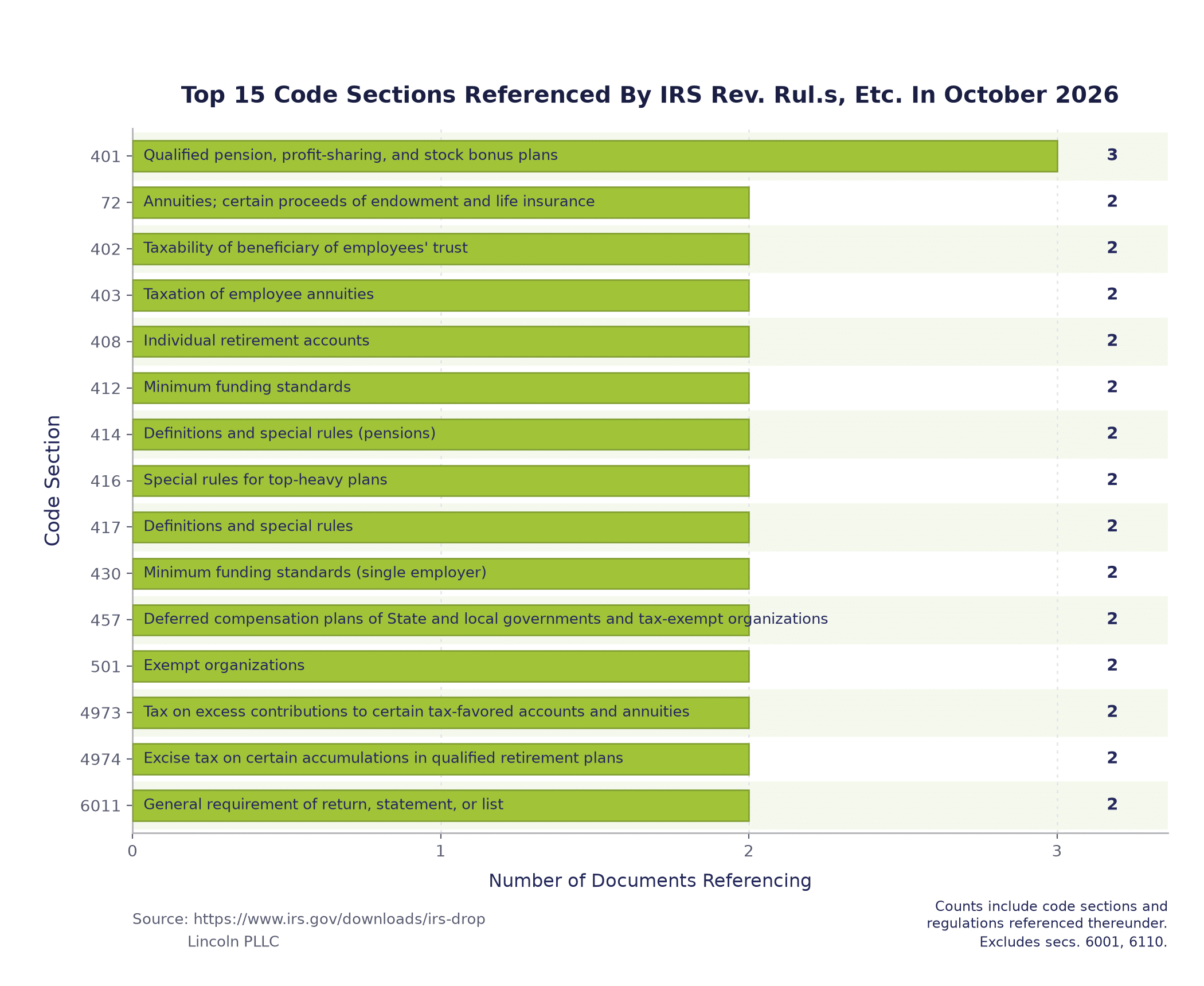
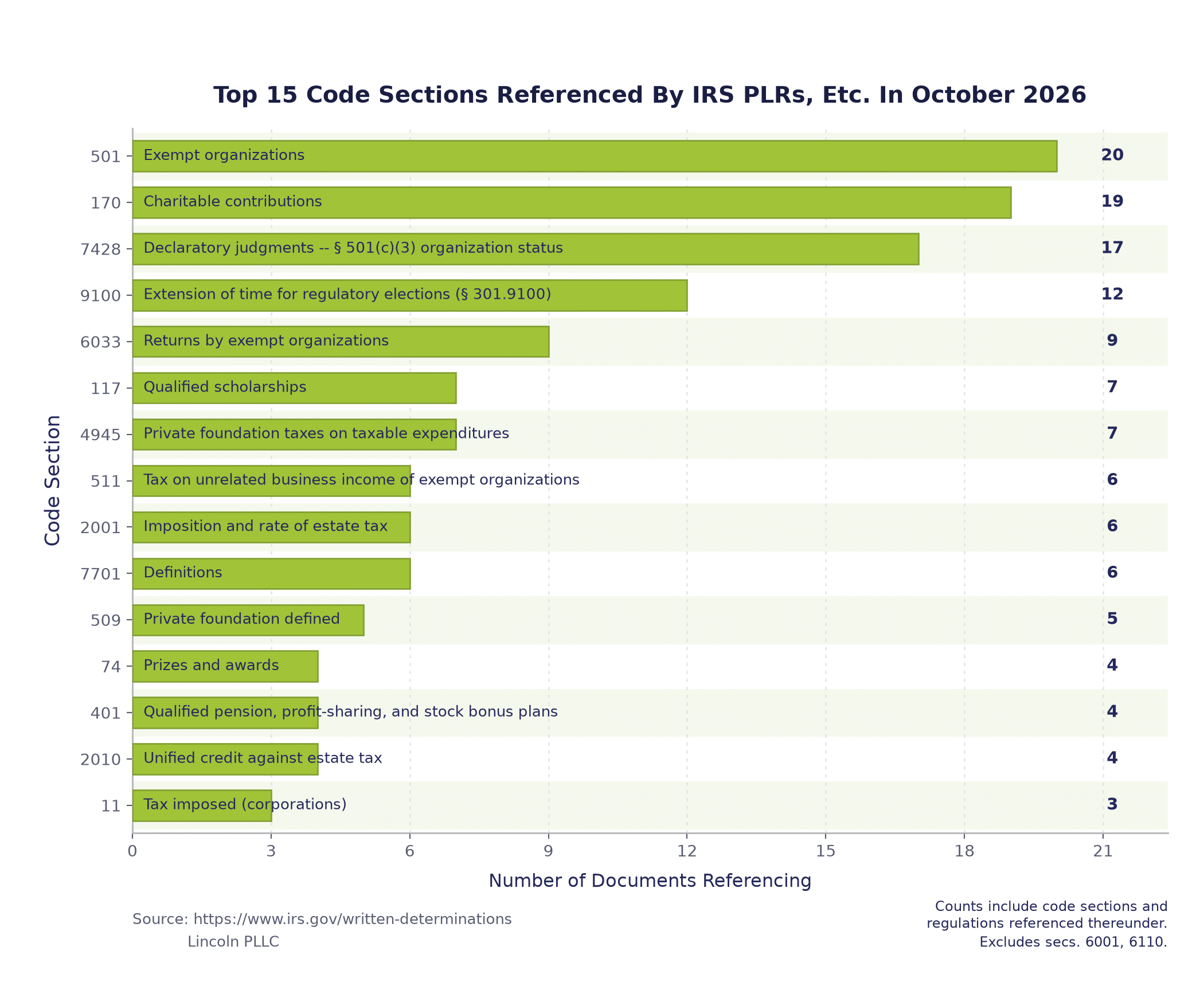
What this is. Periodically, we compile which sections of the Internal Revenue Code the IRS’s newly published guidance and written determinations referenced most often. The charts below rank the most-referenced Code sections for October 2026, with the underlying documents — grouped by type, each with a brief summary and a link to the original — listed beneath.
What’s counted. The sources are IRS written determinations (private letter rulings, technical advice memoranda, and chief counsel advice) and Internal Revenue Bulletin items (revenue rulings, revenue procedures, notices, and announcements). Counting is by document, not by mention — a section a single document cites many times counts once — and §§ 6001 and 6110 are omitted. It’s a research and orientation tool, not legal advice.
Prepared by Erik Lincoln
In October 2026, the IRS published 3 Rev. Procs., 2 Rev. Ruls., and 1 Notice, which included a total of 229 pages.
Document Summaries (6 documents)
Revenue Rulings (2)
Rev. Rul. 2026-21 (Oct. 16, 2026)Code sections referenced: § 42, § 280G, § 382, § 467, § 468, § 482, § 483, § 1274, § 1288, § 7520, § 7702, § 7872
Rev. Rul. 2026-21 is a monthly prescribed-rates revenue ruling addressing the applicable federal rates and related percentages required for various federal income tax computations for November 2026. The ruling establishes the following rates: short-term, mid-term, and long-term AFRs (4.67%, 5.08%, and 5.52% annually, with compounding variants) for section 1274(d); adjusted AFRs (3.54%, 3.85%, and 4.18% annually) for section 1288(b); an adjusted federal long-term rate and long-term tax-exempt rate of 4.18% for section 382; low-income housing credit percentages of 8.24% and 3.53% (with the 9% floor for qualifying buildings) for section 42(b)(1); and a section 7520 present-value rate of 6.20%. The ruling relies on sections 42, 280G, 382, 467, 468, 482, 483, 1274, 1288, 7520, 7702, and 7872 of the Internal Revenue Code.
Rev. Rul. 2026-22 (Oct. 28, 2026)Code sections referenced: § 401, § 416, § 420, § 501
Rev. Rul. 2026-22 is a revenue ruling addressing whether a pension plan's section 401(h) account may pay medical benefits for active employees who, under section 401(a)(36), are eligible to receive in-service distributions upon attaining age 59½ without first separating from employment. The IRS ruled that using section 401(h) account assets to pay medical benefits for such participants does not violate section 401(h) or § 1.401-14, and does not adversely affect the plan's tax-qualified status under section 401(a), because—since separation from employment is not a condition of receiving retirement benefits under the plan—those participants satisfy the definition of "retired" under § 1.401-14(b)(1). The ruling relies on Code sections 401(a), 401(a)(36), 401(h), 416(i), 420, and 501(a), and on 26 CFR §§ 1.401-14(a), 1.401-14(b)(1), and 1.401-14(c).
Revenue Procedures (3)
Rev. Proc. 2026-20 (Oct. 6, 2026)Code sections referenced: § 671, § 677, § 1001, § 6045, § 7701
Rev. Proc. 2026-20 is a revenue procedure that addresses whether digital-asset trusts that otherwise qualify as investment trusts and grantor trusts may stake their digital assets without losing those tax classifications, and whether existing trusts may amend their governing instruments to authorize staking. The IRS and Treasury establish a safe harbor under which a trust's authorization and conduct of staking—through custodians and arm's-length staking providers, subject to SEC disclosure requirements, exchange liquidity rules, slashing indemnification, and quarterly in-kind or cash distribution of staking rewards—will not constitute a power to vary the investment of certificate holders or otherwise impair the trust's status as an investment trust or grantor trust; existing trusts have six months from October 6, 2026, to implement the safe harbor's requirements, and this procedure clarifies, modifies, and supersedes Rev. Proc. 2025-31. The principal authorities relied on are Code sections 671, 677, and 6045(g)(3)(D), Treasury Regulations §§ 301.7701-2 and 301.7701-4(c), and related administrative guidance including Rev. Ruls. 75-192, 78-371, 79-77, 81-238, 90-63, 2004-86, 85-13, and 88-103, as well as Commissioner v. North American Bond Trust, 122 F.2d 545 (2d Cir. 1941).
Rev. Proc. 2026-33 (Oct. 22, 2026)Code sections referenced: § 72, § 219, § 401, § 402, § 403, § 408, § 408A, § 457, § 4973, § 4974, § 6011, § 6103, § 6511, § 7605, § 7805
Rev. Proc. 2026-33 is a revenue procedure that establishes the IRA Compliance Resolution System (ICRS), including its initial component, the IRA Voluntary Correction Program (IVCP), and addresses how IRA Custodians and IRA Owners may correct certain inadvertent IRA failures—specifically RMD Failures, IRA Establishment Failures, Nonspouse Beneficiary Distribution or Rollover Failures, and 60-Day Rollover Failures—and transitions 60-day rollover waiver requests from the private letter ruling process to ICRS. The IRS concludes that eligible Applicants who file Form 15443 via Pay.gov, pay the applicable user fee, and implement corrections specified in a compliance statement will receive IRS assurance that the affected IRA will not be treated as failing to satisfy applicable IRA Requirements and that the IRA Owner will not be subject to related income or excise taxes, with the IRS also retaining discretion to waive the excise taxes under sections 4973, 4974, and 72(t) in appropriate cases. The principal authorities relied on are Code sections 72(t), 219, 401(a)(9), 402(c)(3), 402(c)(4), 403(a), 403(b), 408(a), 408(b), 408(d)(3), 408(d)(3)(C), 408(k), 408(k)(6), 408(p), 408A, 457(b), 4973, 4974, 6103, 6110, 6511(a), 6511(b)(1), 7605(b), and 7805(b), along with Treas. Reg. §§ 1.408-2(e), 1.6011-4(b)(2), and 54.4974-1(g), and prior guidance including Rev. Proc. 2003-16, Rev. Proc. 2016-47, Rev. Proc. 2020-46, Rev. Proc. 2026-4, and Section 305(c) of the SECURE 2.0 Act of 2022, Pub. L. 117-328.
Rev. Proc. 2026-34 (Oct. 22, 2026)Code sections referenced: § 61, § 72, § 83, § 170, § 401, § 402, § 402A, § 403, § 404, § 408, § 410, § 411, § 412, § 414, § 415, § 416, § 417, § 430, § 436, § 457, § 501, § 3121, § 4972, § 4973, § 4974, § 4975, § 4979, § 4979A, § 6011, § 6103, § 6621, § 7605, § 7805
Revenue Procedure 2026-34 is a comprehensive update to the Employee Plans Compliance Resolution System (EPCRS), addressing the procedures and standards under which sponsors of tax-favored retirement plans may correct plan failures through the Self-Correction Program (SCP), the Voluntary Correction Program (VCP), and the Audit Closing Agreement Program (Audit CAP). The revenue procedure expands SCP to permit self-correction of Eligible Inadvertent Failures (including loan, plan document, demographic, and employer eligibility failures), incorporates new rules on the recovery and rollover treatment of Inadvertent Benefit Overpayments, reinstates and broadens the safe harbor for correcting employee elective deferral failures in plans with automatic enrollment features, and makes numerous procedural modifications to VCP and Audit CAP, while modifying and superseding Rev. Proc. 2021-30. The principal authorities relied on are Code sections 401(a), 401(a)(4), 401(a)(9), 401(a)(11), 401(a)(17), 401(a)(26), 401(a)(30), 401(b), 401(c)(3), 401(k), 401(m), 402(c)(8), 402(c)(12), 402(g), 403(a), 403(b), 408(k), 408(p), 410(b), 411, 412(e)(3), 414(aa), 414(cc), 414(l), 414(v), 415, 416, 417, 436, 457(b), 4975(e)(2), 6621(a)(2), and 6621(c)(1), together with the SECURE 2.0 Act (Pub. L. 117-328, sections 301, 305, and 350), Notice 2023-43, Notice 2024-2, Notice 2024-77, and prior revenue procedures including Rev. Proc. 2021-30, Rev. Proc. 2022-40, and Rev. Proc. 2023-37.
Notices (1)
Notice 2026-65 (Oct. 20, 2026)Code sections referenced: § 412, § 414, § 417, § 430, § 431, § 433
Notice 2026-65 is an IRS notice that provides updated interest rate figures—specifically the corporate bond monthly yield curve, spot and 24-month average segment rates, minimum present value segment rates, and 30-year Treasury weighted average rates—used by single-employer and multiemployer defined benefit pension plans to determine funding targets and minimum present value of benefits. For October 2026 plan years, the unadjusted 24-month average segment rates are 4.40, 5.37, and 6.08; the adjusted rates (constrained to 95%–105% of the 25-year averages) vary by plan year from 4.75/5.31/6.08 (2025) to 4.75/5.25/5.89 (2027); the September 2026 spot segment rates are 5.06, 5.99, and 6.72; and the 30-year Treasury weighted average for October 2026 plan years is 4.67%, with a permissible range of 4.20% to 4.90%. The notice relies on §§ 412, 414(y), 417(e)(3), 417(e)(3)(A)(ii)(II), 417(e)(3)(D), 430(h)(2), 430(h)(2)(C)(i)–(iv), 430(h)(2)(D)(ii), 431(c)(6)(A), 431(c)(6)(B), 431(c)(6)(E)(ii)(I), 433(c)(7)(C), and 433(h)(3)(A) of the Internal Revenue Code, as well as Treas. Reg. §§ 1.417(e)-1(d)(3) and 1.430(h)(2)-1(c) and (d), and Notice 88-73.
In October 2026, the IRS published 47 PLRs and 1 CCA, which included a total of 325 pages.
Document Summaries (48 documents)
Private Letter Rulings — § 9100 Relief (12)
Priv. Ltr. Rul. 2026-42-011 (Oct. 16, 2026)Code sections referenced: § 7701, § 9100
Private Letter Ruling 202642011 is a letter ruling responding to Company's request for an extension of time to file a Form 8832 electing partnership classification for federal tax purposes, addressing whether Company satisfied the requirements for relief from the missed election deadline. The IRS concluded that Company met the reasonable-and-good-faith and non-prejudice-to-the-Government standards and granted a 120-day extension from the date of the letter to file Form 8832 electing partnership status effective as of Date, contingent on Company's owners filing all required returns for open years consistent with the relief within the same 120-day period. The ruling relies on §§ 301.7701-2, 301.7701-3, 301.9100-1, 301.9100-2, and 301.9100-3 of the Procedure and Administration Regulations, and cites § 6110(k)(3) of the Code.
Priv. Ltr. Rul. 2026-42-012 (Oct. 16, 2026)Code sections referenced: § 7701, § 9100
Private Letter Ruling 202642012 addresses a request by Company, a foreign entity formed under the laws of Country on Date, for an extension of time to file a Form 8832 electing partnership classification for federal tax purposes after failing to make that election timely. The IRS granted Company a 120-day extension from the date of the ruling to file Form 8832, contingent on Company's owners also filing all required information returns for open years consistent with the relief within the same period. The ruling relies on §§ 301.7701-2, 301.7701-3, 301.9100-1, 301.9100-2, and 301.9100-3 of the Procedure and Administration Regulations, and notes the non-precedential status of the letter under Code § 6110(k)(3).
Priv. Ltr. Rul. 2026-42-013 (Oct. 16, 2026)Code sections referenced: § 7701, § 9100
Private Letter Ruling 202642013 is a letter ruling responding to Company's request for an extension of time to file a Form 8832 electing partnership classification for federal tax purposes, addressing whether Company satisfied the standards for late-election relief after failing to timely file the election effective on Date. The IRS concluded that Company met the requirements for relief under the applicable regulations and granted a 120-day extension from the date of the letter to file Form 8832 electing partnership status effective Date, contingent on Company's owners filing all required returns for open years consistent with the relief within the same 120-day period. The ruling relies on §§ 301.7701-2, 301.7701-3, 301.9100-1, 301.9100-2, and 301.9100-3 of the Procedure and Administration Regulations, and cites § 6110(k)(3) of the Code regarding the non-precedential status of the ruling.
Priv. Ltr. Rul. 2026-43-002 (Oct. 23, 2026)Code sections referenced: § 7701, § 9100
Private Letter Ruling 202643002 is a ruling responding to X's request for an extension of time to file Form 8832, Entity Classification Election, after X, a limited liability company formed under State law, failed to timely elect to be classified as an association taxable as a corporation effective Date. The IRS concluded that X satisfied the requirements for discretionary relief and granted X a 120-day extension from the date of the ruling to file Form 8832 with the appropriate service center to achieve corporate classification effective Date. The ruling relies on §§ 301.7701-2, 301.7701-3, 301.9100-1, 301.9100-2, and 301.9100-3 of the Procedure and Administration Regulations, as well as § 6110(k)(3) of the Code.
Priv. Ltr. Rul. 2026-43-005 (Oct. 23, 2026)Code sections referenced: § 2001, § 2010, § 2056, § 2101, § 9100
Private Letter Ruling 202643005 addresses a request by the estate of Decedent for an extension of time to make a qualified terminable interest property (QTIP) election under § 2056(b)(7) with respect to Marital Trust, after Tax Professional mistakenly omitted Marital Trust from Schedule M of the timely filed Form 706 and filed a Supplemental Form 706 on Date 4 to correct the omission. The IRS granted the extension of time to Date 4 to make the QTIP election, concluding that the requirements of § 301.9100-3 were satisfied because Decedent's estate reasonably relied on Tax Professional, who failed to make the election, and granting relief would not prejudice the government's interests. The ruling relies on §§ 2001(a), 2056(a), 2056(b)(7)(A), 2056(b)(7)(B)(i), (ii), and (v), 20.2056(b)-7(b)(4)(i), 301.9100-1(c), 301.9100-3, and 301.9100-3(b)(1)(v).
Priv. Ltr. Rul. 2026-43-007 (Oct. 23, 2026)Code sections referenced: § 1400Z, § 6501, § 6662, § 9100
Private Letter Ruling 202643007 is a letter ruling responding to Taxpayer's request for an extension of time to file Form 8996 to self-certify as a qualified opportunity fund (QOF) for its taxable year ended Date 3, after Taxpayer's Accounting Firm failed through administrative oversight to attach the completed Form 8996 to Taxpayer's timely filed Year 1 Form 1065. The IRS concluded that Taxpayer acted reasonably and in good faith by reasonably relying on a qualified tax professional who failed to make the election, and that granting relief would not prejudice the interests of the government, and accordingly granted Taxpayer a 60-day extension from the date of the ruling to file Form 8996 attached to an amended return or administrative-adjustment request. The ruling relies on section 1400Z-2(d) and section 1400Z-2(e)(4)(A) of the Code, Treas. Reg. sections 1.1400Z2(d)-1(a)(2)(i) and 1.1400Z2(d)-1(a), and Treas. Reg. sections 301.9100-1, 301.9100-3(a), 301.9100-3(b), 301.9100-3(c)(1)(i), and 301.9100-3(c)(1)(ii), with reference to section 6501(a) on the limitations period and section 6662 on accuracy-related penalties.
Priv. Ltr. Rul. 2026-43-008 (Oct. 23, 2026)Code sections referenced: § 2001, § 2010, § 6018, § 9100
Private Letter Ruling 202643008 is a ruling responding to a request by Decedent's estate for an extension of time to make a portability election under § 2010(c)(5)(A), allowing Spouse to utilize Decedent's deceased spousal unused exclusion (DSUE) amount after the estate failed to timely file Form 706. The IRS granted a 120-day extension from the date of the letter in which to file a complete and properly prepared Form 706 electing portability, conditioned on the estate's gross estate not independently requiring a return under § 6018(a), and noted that the extension would be null and void if that condition is later found unsatisfied. The ruling relies principally on §§ 2001, 2010(c)(1)–(5), and 6018(a) of the Code, together with Treas. Reg. §§ 20.2010-2(a)(1), 20.2010-3(c)(1) and (d), 301.9100-1(c), and 301.9100-3, as well as Pub. L. No. 111-312, § 303.
Priv. Ltr. Rul. 2026-43-009 (Oct. 23, 2026)Code sections referenced: § 734, § 743, § 754, § 6031, § 6227, § 9100
Private Letter Ruling 202643009 is a letter ruling addressing whether X, a State-formed LLC treated as a partnership, qualifies for an extension of time to file a § 754 election that was inadvertently omitted for the taxable year ended Date 3, the year in which A purchased an interest in X. The IRS granted X a 120-day extension from the date of the ruling to make the § 754 election, conditioned on X filing amended returns or AARs reflecting the § 734(b) and § 743(b) basis adjustments that would have applied had the election been timely made, and on X's partners correspondingly reducing the bases of their partnership interests. The ruling relies on §§ 754, 734, 743, and 6227(b) of the Code, and on Treas. Reg. §§ 1.754-1(b), 1.6031(a)-1(e), 301.9100-1, 301.9100-2, and 301.9100-3.
Priv. Ltr. Rul. 2026-43-010 (Oct. 23, 2026)Code sections referenced: § 2001, § 2010, § 6018, § 9100
Private Letter Ruling 202643010 is a ruling responding to a request by Decedent's estate for an extension of time to make a portability election under § 2010(c)(5)(A), where an estate tax return was not timely filed despite the estate having an unused applicable exclusion amount that Spouse sought to utilize as a DSUE amount. The IRS granted a 120-day extension from the date of the letter (July 24, 2026) in which Decedent's estate may file a complete and properly prepared Form 706 to make the portability election, conditioned on the estate remaining one not required to file under § 6018(a) based on the value of its gross estate and adjusted taxable gifts, and subject to nullification if that condition proves unsatisfied. The ruling relies principally on §§ 2001, 2010(a), 2010(c)(1)–(5), and 6018(a) of the Code, and on Treas. Reg. §§ 20.2010-2(a)(1) and (a)(2), 20.2010-3(c)(1) and (d), 301.9100-1(c), 301.9100-2, and 301.9100-3, as well as the Tax Relief, Unemployment Insurance Reauthorization, and Job Creation Act of 2010, Pub. L. No. 111-312, § 303.
Priv. Ltr. Rul. 2026-43-011 (Oct. 23, 2026)Code sections referenced: § 7701, § 9100
Private Letter Ruling 202643011 is a ruling responding to a request by X, a foreign entity organized under the laws of Country on Date, for an extension of time to file a Form 8832 electing disregarded entity status for federal tax purposes after X missed the original filing deadline. The IRS concluded that X satisfied the requirements of § 301.9100-3—having acted reasonably and in good faith without prejudice to the government's interests—and granted X a 120-day extension from the date of the letter to file a properly executed Form 8832 effective Date, contingent on X's owner filing all required returns for open years consistent with the relief granted. The ruling relies on §§ 301.7701-2, 301.7701-3(a), (b)(2), (c), and (d), and §§ 301.9100-1 through 301.9100-3 of the Procedure and Administration Regulations, as well as § 6110(k)(3) of the Code.
Priv. Ltr. Rul. 2026-43-012 (Oct. 23, 2026)Code sections referenced: § 2001, § 2010, § 6018, § 9100
Private Letter Ruling 202643012 responds to a request by Decedent's estate—whose gross estate does not require a Form 706 filing under § 6018(a)—for an extension of time to make a portability election under § 2010(c)(5)(A), which was missed because no estate tax return was timely filed. The IRS granted a 120-day extension from the date of the letter (July 30, 2026) within which Decedent's estate must file a complete and properly prepared Form 706 to elect portability of Decedent's deceased spousal unused exclusion (DSUE) amount for Spouse's benefit, conditioned on the estate's representations being accurate and subject to nullification if the estate is later found to have been required to file under § 6018(a). The ruling relies on §§ 2001(a), 2010(a), 2010(c)(1)–(5)(A), 6018(a), 301.9100-1(c), 301.9100-3, 20.2010-2(a)(1) and (a)(2), and 20.2010-3(c)(1) and (d), as well as Pub. L. No. 111-312, § 303.
Priv. Ltr. Rul. 2026-43-013 (Oct. 23, 2026)Code sections referenced: § 856, § 6501, § 6662, § 9100
Private Letter Ruling 202643013 (July 8, 2026) responds to a request by Taxpayer, a REIT, and Subsidiary, a limited liability company owned indirectly through Taxpayer's operating partnership, for an extension of time to make a taxable REIT subsidiary election on Form 8875 effective Date 1, where both the entity classification election on Form 8832 and the TRS election were inadvertently not filed due to miscommunications surrounding a Tax Return Preparer team member's departure. The IRS concluded that Taxpayer and Subsidiary acted reasonably and in good faith and that granting relief would not prejudice the Government's interests, and accordingly ruled that the Form 8875 filed on Date 6 would be treated as timely filed with an effective date of Date 1. The ruling relies on Code sections 856(l), 6501(a), and 6662, Treas. Reg. §§ 301.9100-1, 301.9100-2, and 301.9100-3, and Announcement 2001-17, 2001-8 C.B. 716.
Private Letter Rulings — Other (35)
Priv. Ltr. Rul. 2026-42-010 (Oct. 16, 2026)Code sections referenced: § 301, § 7701
Private Letter Ruling 202642010 is a ruling responding to a request by X, a foreign eligible entity formed under the laws of Country, for the IRS's consent to change its federal tax classification from a disregarded entity to an association taxable as a corporation effective Date 3, within the sixty-month waiting period following its prior classification election effective Date 2. The IRS consented to the reclassification because a series of transactions concluding on Date 3 resulted in a change in ownership of more than fifty percent, satisfying the exception to the sixty-month restriction, and directed X to file Form 8832 with a copy of the ruling attached, in accordance with Rev. Proc. 2009-41. The ruling relies on Treas. Reg. §§ 301.7701-2(b), 301.7701-3(a), 301.7701-3(b)(2)(i), 301.7701-3(c)(1)(i), 301.7701-3(c)(1)(iii), and 301.7701-3(c)(1)(iv), and cites § 6110(k)(3) of the Code regarding non-precedential status.
Priv. Ltr. Rul. 2026-42-014 (Oct. 16, 2026)Code sections referenced: § 11, § 61, § 170, § 501, § 511, § 6033, § 7428
Private Letter Ruling 202642014 is a final adverse determination letter, accompanied by a Form 886-A explanation of items, addressing whether the Organization continues to qualify for federal income tax exemption under IRC Section 501(c)(3) after it failed to respond to repeated IRS audit correspondence and information document requests. The IRS concluded that the Organization's exempt status is revoked because its failure to produce records and cooperate with the examination means it did not establish that it is organized and operated exclusively for one or more exempt purposes, as required under the organizational and operational tests. The determination relies on IRC Sections 501(a), 501(c)(3), 511, 6001, and 6033; Treasury Regulation Sections 1.501(c)(3)-1(a) and (a)(1), 1.61-1, 1.6001-1(c) and (e), and 1.6033-1(h)(2); and Revenue Ruling 59-95, with IRC Section 7428 noted as the remedy available to the Organization to contest the determination by petition to the United States Tax Court, the United States Court of Federal Claims, or the United States District Court for the District of Columbia.
Priv. Ltr. Rul. 2026-42-015 (Oct. 16, 2026)Code sections referenced: § 170, § 501, § 6104, § 7428
Private Letter Ruling 202642015 is a final adverse determination letter, together with the underlying proposed adverse determination, addressing whether a public benefit corporation formed to provide fee-based grant-matching and management services connecting research funders to research teams qualifies for exemption from federal income tax as an organization described in IRC Section 501(c)(3). The IRS concluded that the Organization does not qualify because it fails the operational test: its primary activities constitute commercial management and consulting services that confer direct benefits on fee-paying clients rather than exclusively furthering educational or scientific purposes, and its substantial nonexempt purpose precludes exemption regardless of any incidental public benefit from the publication of research findings. The determination rests on IRC Sections 501(a), 501(c)(3), and 170, Treasury Regulation Sections 1.501(c)(3)-1(a)(1), 1.501(c)(3)-1(c)(1), 1.501(c)(3)-1(d)(3)(i), 1.501(c)(3)-1(d)(5)(ii)(a)–(b), and 1.501(c)(3)-1(d)(5)(iii)(a), IRC Sections 6104(c), 6110, and 7428(b)(2), and Revenue Rulings 65-60, 69-528, 71-529, 72-369, and 76-296, as informed by Better Business Bureau of Washington, D.C., Inc. v. United States, 326 U.S. 279 (1945), B.S.W. Group, Inc. v. Commissioner, 70 T.C. 352 (1978), and Washington Research Foundation v. Commissioner, T.C. Memo 1985-570.
Priv. Ltr. Rul. 2026-42-016 (Oct. 16, 2026)Code sections referenced: § 501, § 7428
Private Letter Ruling 202642016 is a final adverse determination letter, accompanied by a Form 886-A examination report, addressing whether a residential homeowners' association continues to qualify for federal income tax exemption as a social club under IRC Section 501(c)(7). The IRS concluded that the Organization does not qualify because substantially all of its activities—maintaining residential roads, enforcing restrictive covenants, providing security patrol services, and offering trash collection—are directed toward preserving a residential neighborhood rather than toward the pleasure, recreation, and fellowship of members, and because membership attaches automatically to property ownership rather than arising from personal association and commingling. The determination relies on IRC Section 501(c)(7), Treasury Regulation Section 1.501(c)(7)-1(a), Rev. Rul. 58-589, and Rev. Rul. 75-494, with IRC Section 7428 governing the Organization's right to seek declaratory judgment within 90 days.
Priv. Ltr. Rul. 2026-42-017 (Oct. 16, 2026)Code sections referenced: § 170, § 501, § 511, § 6033, § 7428
Private Letter Ruling 202642017 is a final adverse determination letter, accompanied by a Form 886-A examination report, addressing whether the Organization qualifies for exemption from federal income tax as a Section 501(c)(3) charitable or educational organization. The IRS revoked the Organization's exempt status on the grounds that it failed both the organizational test—by never producing its Articles of Incorporation, Bylaws, or other governing documents—and the operational test, because its repeated failure to provide books, records, financial statements, or documentation of its activities in response to four Information Document Requests left the IRS unable to verify that the Organization was organized and operated exclusively for exempt purposes. The determination relies on IRC Sections 501(a), 501(c)(3), 6001, and 6033; Treasury Regulation Sections 1.501(c)(3)-1(a)(1), 1.501(c)(3)-1(b)(4), 1.501(c)(3)-1(c)(1), 1.6001-1(c), and 1.6001-1(e); Rev. Rul. 59-95, 1959-1 C.B. 627; and Harding Hospital, Inc. v. United States, 505 F.2d 1068 (6th Cir. 1974), with IRC Section 7428 governing the Organization's right to seek declaratory judgment within 90 days.
Priv. Ltr. Rul. 2026-42-018 (Oct. 16, 2026)Code sections referenced: § 501, § 511, § 6033, § 7428
Private Letter Ruling 202642018 is a final adverse determination letter, accompanied by a proposed-action letter and Form 886-A explanation, addressing whether a subordinate organization that had been included in a group exemption ruling under its Parent Organization should have its section 501(c)(3) exempt status revoked for failing to respond to repeated IRS information requests and for failing to demonstrate it was organized and operated exclusively for exempt purposes. The IRS concluded that the organization's exempt status must be revoked because it did not produce sufficient records to satisfy the organizational and operational tests, the Parent Organization's group exemption had itself been automatically revoked, and no new application for exempt status had been filed. The determination rests principally on IRC sections 501(a), 501(c)(3), 511, 6001, and 6033, Treasury Regulations sections 1.501(c)(3)-1, 1.6001-1, and 1.6033-1, and Rev. Rul. 59-95, with section 7428 identified as the avenue for declaratory judgment review and Notice 2020-36 cited in connection with the group exemption framework.
Priv. Ltr. Rul. 2026-43-001 (Oct. 23, 2026)Code sections referenced: § 368, § 1202, § 1361, § 1362
Private Letter Ruling 202643001 addresses whether the potential termination of Sub's S corporation election and the potential ineffectiveness of X's Qualified Subchapter S Subsidiary election for Sub—both arising from funding agreements with C and D, business entities ineligible to hold S corporation stock that may have created a second class of stock—qualify for inadvertent termination relief. The IRS ruled that the circumstances causing both the potential S corporation termination (on Date 2 and, if not already terminated, Date 3) and the potential QSub election ineffectiveness (effective Date 5) were inadvertent, and therefore Sub will be treated as an S corporation from Date 2 through Date 5 and as a QSub from Date 5 through Date 6, subject to the condition that X, Sub, A, B, C, and D not treat C and D as holding equity in Sub for any federal tax purpose, including determination of the holding period of A Corp stock under § 1202. The ruling principally relies on §§ 1361(a)(1), 1361(b)(1), 1361(b)(3)(B), 1362(a), 1362(d)(2), and 1362(f), together with Treas. Reg. §§ 1.1361-1(l)(1), 1.1361-1(l)(2)(i), and 1.1362-4(d), and cites Rev. Rul. 64-250 and Rev. Rul. 2008-18 with respect to X's succession to Sub's S corporation election.
Priv. Ltr. Rul. 2026-43-003 (Oct. 23, 2026)Code sections referenced: § 2001, § 2055, § 2503, § 2522, § 2601, § 2602, § 2611, § 2631, § 2632, § 2642, § 6075
Private Letter Ruling 202643003 is a ruling responding to a request by the executors of Taxpayer's estate for an extension of time under § 2642(g) to allocate GST exemption to transfers Taxpayer made in Year 1 to four irrevocable trusts for the benefit of Child 1, Child 2, Child 3, and Child 4 and their descendants, where a clerical error by Attorney caused only a portion of the intended GST exemption to be reported as automatically allocated on the timely filed Form 709. The IRS concluded that the requirements of § 26.2642-7 were satisfied—finding that Taxpayer acted reasonably and in good faith and that granting relief would not prejudice the government—and granted the executors a 120-day extension from the date of the letter to allocate GST exemption to the Year 1 transfers to Trust 1, Trust 2, Trust 3, and Trust 4, with the allocation to be effective as of the date of Taxpayer's original transfers and valued for federal gift tax purposes. The ruling relies on Code §§ 2601, 2602, 2611(a), 2631, 2632(a), 2632(c)(1), 2632(c)(3)(A) and (B)(iv), 2632(c)(5)(A)(ii), 2642(a), 2642(b)(1)(A), and 2642(g)(1), together with Treas. Reg. §§ 26.2642-7(d)(1), (d)(2), (d)(3), and (e)(1).
Priv. Ltr. Rul. 2026-43-004 (Oct. 23, 2026)Code sections referenced: § 2001, § 2055, § 2503, § 2522, § 2601, § 2602, § 2611, § 2631, § 2632, § 2642, § 6075
Private Letter Ruling 202643004 is a ruling responding to a request by the executors of Taxpayer's estate for an extension of time to allocate GST exemption to transfers Taxpayer made in Year 1 to four trusts for the benefit of Child 1, Child 2, Child 3, and Child 4 and their descendants, where a clerical error by Attorney caused the Form 709 to report an automatic GST exemption allocation of only $b rather than the full transfer amount of $a. The IRS granted a 120-day extension from the date of the ruling for the executors to allocate Taxpayer's GST exemption to the Year 1 transfers to Trust 1, Trust 2, Trust 3, and Trust 4, with the allocation to be effective as of the date of Taxpayer's original transfers and valued for federal gift tax purposes, to be reported on an amended Form 709 for Year 1. The ruling relies on Code sections 2601, 2602, 2611(a), 2631(a) and (b), 2632(a)(1) and (2), 2632(c)(1), (3)(A), (3)(B)(iv), and (5)(A)(ii), 2642(a)(1), 2642(b)(1)(A), and 2642(g)(1)(A) and (B), as well as Treasury Regulations §§ 26.2642-7(d)(1), (d)(2), (d)(3), and (e)(1).
Priv. Ltr. Rul. 2026-43-006 (Oct. 23, 2026)Code sections referenced: § 465, § 469, § 643, § 661, § 662, § 663, § 678, § 1361, § 1362
A private letter ruling responding to X's request for relief under § 1362(f), addressing whether X's S corporation election termination was inadvertent after Trust's income beneficiaries, B and C, failed to timely file QSST elections when Trust ceased to qualify as an eligible shareholder following the expiration of the two-year post-death period under § 1361(c)(2)(A)(ii). The IRS concluded that the termination of X's S election on Date 4 was inadvertent within the meaning of § 1362(f) and ruled that X will be treated as continuing as an S corporation from Date 4 forward, contingent on B and C filing QSST elections with the appropriate service center within 120 days of the ruling date. The principal authorities relied on are §§ 663(c), 1361(a)(1), 1361(b)(1), 1361(c)(2)(A)(i) and (ii), 1361(d)(1)–(3), 1362(a), 1362(d)(2), and 1362(f), together with Treas. Reg. §§ 1.663(c)-1(a), 1.1361-1(j)(3), 1.1361-1(j)(6)(i)–(iii), and § 6110(k)(3).
Priv. Ltr. Rul. 2026-43-015 (Oct. 23, 2026)Code sections referenced: § 170, § 501, § 6104, § 7428
Private Letter Ruling 202643015 is a final adverse determination letter, accompanied by the underlying proposed adverse determination, addressing whether an organization that operates a community co-ed adult slow-pitch softball league qualifies for federal income tax exemption under IRC Section 501(c)(3). The IRS concluded that the organization fails both the organizational test—because its Articles of Incorporation limit its purpose to operating an adult softball league without a qualifying dissolution clause—and the operational test, because its sole activity is providing social and recreational sports opportunities for adults rather than exclusively furthering exempt purposes, and because it does not foster national or international amateur sports competition sufficient to qualify as a qualified amateur sports organization under IRC Section 501(i)(2). The determination rests on IRC Sections 501(c)(3), 501(i)(2), 170, 6104(c), 6110, and 7428(b)(2); Treasury Regulation Sections 1.501(c)(3)-1(a)(1), 1.501(c)(3)-1(b)(1)(i), 1.501(c)(3)-1(b)(4), and 1.501(c)(3)-1(c)(1); and Revenue Rulings 70-4 and 80-215, as well as Better Business Bureau of Washington D.C., Inc. v. United States, 326 U.S. 279 (1945), Hutchinson Baseball Enterprises v. Commissioner, 696 F.2d 757 (1982), Minnesota Kingsmen Chess Ass'n v. Commissioner, T.C. Memo. 1983-495, St. Louis Science Fiction Ltd. v. Commissioner, 49 T.C.M. 1126 (1985), and International Postgraduate Medical Foundation v. Commissioner, T.C. Memo. 1989-36.
Priv. Ltr. Rul. 2026-43-016 (Oct. 23, 2026)Code sections referenced: § 401, § 501, § 502, § 512, § 6033, § 7428
Private Letter Ruling 202643016 is a final adverse determination letter, accompanied by a Form 886-A explanation of items, addressing whether a veterans' post that had been covered under a group ruling retains its tax-exempt status under IRC Section 501(c)(19). The IRS revoked the Organization's exempt status because its membership records showed that veteran members constituted significantly less than the required 75 percent of total membership, and social members with no affiliated military service constituted significantly more than the permitted 2.5 percent, causing the Organization to fail both the primary and auxiliary membership tests notwithstanding its otherwise qualifying exempt purposes. The determination relies on IRC Section 501(c)(19), Treasury Regulation Section 1.501(c)(19)-1(a) and (b), IRC Section 7428, Rev. Rul. 59-95, Rev. Proc. 80-27 (1980-1 C.B. 677), IRC Section 6033, and Treasury Regulation Section 1.512(a)-1(a).
Priv. Ltr. Rul. 2026-43-017 (Oct. 23, 2026)Code sections referenced: § 501, § 7428
Private Letter Ruling 202643017 is a final adverse determination letter (incorporating a proposed adverse determination) addressing whether a voluntary membership association formed as a domestic nonstock corporation in State B qualifies for federal income tax exemption as a voluntary employees' beneficiary association. The IRS concluded that the organization does not qualify under IRC Section 501(c)(9) because its membership is not composed of employees, is not defined by reference to an employment-related common bond, and does not satisfy the 90-percent employee-membership test on at least one day per quarter of any taxable year. The determination rests on IRC Section 501(c)(9), Treasury Regulation Sections 1.501(c)(9)-1(a) and 1.501(c)(9)-2(a)(1), Revenue Ruling 85-199, and IRC Section 7428(b)(2).
Priv. Ltr. Rul. 2026-43-018 (Oct. 23, 2026)Code sections referenced: § 170, § 501, § 7428
Private Letter Ruling 202643018 is a final adverse determination letter, accompanied by a Form 886-A explanation of items, addressing whether Organization continues to qualify for federal income tax exemption under IRC Section 501(c)(3) after examination revealed that it was operated primarily as a fundraising conduit channeling funds to a related for-profit entity whose owner also controlled Organization's bookkeeping, with little independent charitable activity and no proper loan documentation for transfers made to the for-profit. The IRS concluded that Organization's exemption under IRC Section 501(c)(3) is revoked because direct fund transfers to the for-profit entity constitute prohibited private inurement, Organization failed the operational test by devoting a substantial part of its activities to financing a for-profit rather than pursuing exempt purposes, and Organization conceded that its inactivity and subsidization of the for-profit were not anomalous but typical of its operations. The determination relies on IRC Sections 501(c)(3), 170, and 7428; Treasury Regulations Sections 1.501(c)(3)-1(a), 1.501(c)(3)-1(c)(1), 1.501(c)(3)-1(c)(2), 1.501(c)(3)-1(d)(1)(ii), and 1.501(c)(3)-1(d)(2); and the authorities of Better Business Bureau of Washington, D.C. v. United States, 326 U.S. 279 (1945), Est of Hawaii v. Commissioner, 71 T.C. 1067 (1979), Community Education Foundation v. Commissioner, T.C. Memo. 2016-223 (2016), and Revenue Ruling 75-384.
Priv. Ltr. Rul. 2026-43-019 (Oct. 23, 2026)Code sections referenced: § 170, § 501, § 7428
Private Letter Ruling 202643019 is a final adverse determination letter, supported by a Form 886-A examination report, addressing whether the Organization's tax-exempt status under IRC Section 501(c)(3) should be revoked for failure to operate exclusively for exempt purposes. The IRS concluded that revocation was warranted because the Organization had been in "standby mode" since a redacted date and had used a substantial portion of its activities as a shared-services vehicle for the founder's for-profit businesses, thereby failing the operational test, with the consequence that the Organization must file Form 1120 for post-revocation tax periods and contributions to it are no longer deductible. The determination rests on IRC Sections 501(a), 501(c)(3), 170, and 7428, and on Treasury Regulations Sections 1.501(c)(3)-1, 1.501(c)(3)-1(a)(1), and 1.501(c)(3)-1(c)(1).
Priv. Ltr. Rul. 2026-43-020 (Oct. 23, 2026)Code sections referenced: § 170, § 501, § 7428
Private Letter Ruling 202643020, together with the accompanying Letter 3618 proposal and Form 886-A audit report, addresses whether an organization's IRC § 501(c)(3) tax-exempt status should be revoked because its actual operations consist predominantly of selling alcohol, a non-exempt commercial activity. The IRS determined that revocation is required because more than 67 percent of the organization's activities consisted of alcohol sales, causing the organization to fail the operational test by devoting more than an insubstantial part of its activities to a non-exempt purpose, and the final adverse determination letter revokes the prior exemption ruling and states that contributions are no longer deductible under IRC § 170. The authorities relied on are IRC §§ 501(a), 501(c)(3), 170, and 7428, Treasury Regulation § 1.501(c)(3)-1 (including subsections addressing the organizational and operational tests), and Starving v. Commissioner, T.C. Memo. 2026-1.
Priv. Ltr. Rul. 2026-43-021 (Oct. 23, 2026)Code sections referenced: § 11, § 61, § 170, § 501, § 511, § 6033, § 7428
Private Letter Ruling 202643021 is a final adverse determination letter, accompanied by a Form 886-A examination report, addressing whether an organization previously recognized as exempt under IRC Section 501(c)(3) should have that status revoked for failing to respond to repeated IRS requests for records and information needed to verify its organized and operational compliance with exempt-organization requirements. The IRS concluded that the organization's failure to produce records or otherwise respond to examination correspondence and telephone contacts made it impossible to establish that the organization satisfies either the organizational or operational test for exemption, and accordingly revoked its exempt status effective the date stated in the letter, with Form 1120 required for subsequent tax periods. The determination relies on IRC Sections 501(a), 501(c)(3), 511, 6001, and 6033; Regulations Sections 1.501(c)(3)-1(a)(1), 1.501(c)(3)-1(c)(1), 1.6001-1(c), 1.6001-1(e), 1.6033-1(h)(2), and 1.61-1; IRC Section 7428 (governing declaratory judgment); and Rev. Rul. 59-95, 1959-1 C.B. 627.
Priv. Ltr. Rul. 2026-43-022 (Oct. 23, 2026)Code sections referenced: § 501, § 7428
Private Letter Ruling 202643022 consists of a proposed and final adverse determination issued to an organization that had been automatically revoked as an IRC Section 501(c)(6) entity and sought retroactive reinstatement, presenting the question whether the organization qualifies for federal income tax exemption as a business league. The IRS concluded that the organization does not qualify under IRC Section 501(c)(6) because its primary activity—holding special events at members' F-producing businesses located within a single city and operating a website with profiles of and links to each member's business—constitutes the performance of particular services for individual members rather than activity directed to the improvement of business conditions of a line of business as a whole, and the organization's argument that other similar organizations have received exemption does not establish an entitlement to the same treatment. The determination relies on IRC Section 501(c)(6), Treasury Regulation Section 1.501(c)(6)-1, Rev. Rul. 55-444, Rev. Rul. 64-315, Rev. Rul. 67-77, Rev. Rul. 67-295, Rev. Rul. 73-411, IRC Section 7428(b)(2), IRC Section 6110, and the cases Washington State Apples, Inc. v. Commissioner, 46 B.T.A. 64 (1942); National Muffler Dealers Ass'n, Inc. v. United States, 440 U.S. 472 (1979); Engineers Club of San Francisco v. United States, 791 F.2d 686 (9th Cir. 1986); City of Galveston, Texas v. United States, 33 Fed. Cl. 685 (1995); and Bluetooth SIG Inc. v. United States, 611 F.3d 617 (9th Cir. 2010).
Priv. Ltr. Rul. 2026-43-023 (Oct. 23, 2026)Code sections referenced: § 72, § 401, § 408, § 408A
Private Letter Ruling 202643023 (July 29, 2026) responds to Taxpayer A's request for a waiver of the 60-day IRA rollover requirement after she withdrew Amount 1 from Roth IRA B and the funds were placed by Individual 1 of Financial Institution D into a non-IRA account holding gold and silver coins rather than being rolled over into a Roth IRA, contrary to Taxpayer A's understanding and intent. The IRS granted the waiver, finding the information submitted consistent with Taxpayer A's assertion that a financial error by Individual 1 prevented a timely rollover, giving Taxpayer A 60 days from issuance of the ruling to contribute Amount 1 into a rollover Roth IRA, after which the contribution will be treated as a valid rollover under section 408(d)(3) provided all other rollover requirements are satisfied. The ruling relies principally on sections 408(a), 408(d)(1), 408(d)(3)(A), 408(d)(3)(B), 408(d)(3)(D), 408(d)(3)(E), and 408(d)(3)(I) of the Code, as well as Revenue Procedure 2003-16, 2003-4 I.R.B. 359, and notes the inapplicability of section 401(a)(9) required minimum distribution rules; the ruling is non-precedential under section 6110(k)(3).
Priv. Ltr. Rul. 2026-43-024 (Oct. 23, 2026)Code sections referenced: § 501, § 6033
A Private Letter Ruling issued by the IRS Exempt Organizations Rulings and Agreements office addresses an organization's request to be relieved of the obligation to file Form 990, Return of Organization Exempt from Income Tax. The IRS determined that the organization qualifies as a governmental unit or an affiliate of a governmental unit and is therefore not required to file Form 990. The ruling relies on IRC Section 6033(a)(3)(B), IRC Section 501(a), IRC Section 501(c)(3), IRC Section 6110, and Revenue Procedure 95-48.
Priv. Ltr. Rul. 2026-43-025 (Oct. 23, 2026)Code sections referenced: § 501, § 6033
A Private Letter Ruling issued by the IRS Exempt Organizations Rulings and Agreements office addresses whether the requesting organization qualifies for an exemption from the Form 990 filing requirement. The IRS determined that the organization qualifies as an integrated auxiliary of a church and therefore is not required to file Form 990. The ruling relies on IRC Section 501(a), IRC Section 501(c)(3), IRC Section 6110, Treasury Regulation Section 1.6033-2(g)(1)(i), and Treasury Regulation Section 1.6033-2(h).
Priv. Ltr. Rul. 2026-43-026 (Oct. 23, 2026)Code sections referenced: § 74, § 117, § 170, § 509, § 4945
Private Letter Ruling 202643026 is an advance approval letter issued by the IRS to a private foundation addressing whether the foundation's scholarship and educational travel grant procedures satisfy the requirements for exclusion from taxable expenditure status under the private foundation excise tax rules. The IRS approved both programs, determining that the scholarship procedures meet the requirements of IRC Section 4945(g)(1) and that the educational travel grant procedures meet the requirements of IRC Section 4945(g)(3), so that expenditures made under either program will not constitute taxable expenditures. The ruling relies on IRC Sections 4945, 4945(d)(3), 4945(g), 4945(g)(1), 4945(g)(3), 117(a), 117(b), 170(b)(1)(A)(i), 170(b)(1)(A)(ii), 170(c)(2)(B), 509(a)(1), 74(b), and 6110, as well as Treasury Regulation Section 53.4945-4(c)(1).
Priv. Ltr. Rul. 2026-43-027 (Oct. 23, 2026)Code sections referenced: § 72, § 401, § 408
Private Letter Ruling 202643027 addresses a request by Taxpayer A for a waiver of the 60-day IRA rollover requirement after Taxpayer A withdrew Amount 1 from IRA B, a SEP IRA, on Date 5 and was unable to complete a timely rollover because Individuals 1 and 2 perpetrated a fraud scheme—impersonating agents of Agency C and a federal prosecutor—that caused Taxpayer A to transfer the funds into a checking account with Bank D and subsequently into a cryptocurrency exchange account with Financial Institution E. The IRS granted the waiver, finding the information submitted consistent with Taxpayer A's assertion of being the victim of a fraud scheme, and allowed Taxpayer A 60 days from issuance of the ruling to contribute Amount 1 into a rollover IRA, with the contribution to be treated as a valid rollover provided all other requirements are satisfied. The ruling relies on sections 408(a), 408(d)(1), 408(d)(3)(A), 408(d)(3)(B), 408(d)(3)(D), 408(d)(3)(E), 408(d)(3)(I), 408(k), 401(a)(9), and 6110(k)(3) of the Code, as well as Revenue Procedure 2003-16.
Priv. Ltr. Rul. 2026-43-028 (Oct. 23, 2026)Code sections referenced: § 170, § 501, § 509, § 4942
A private letter ruling addresses whether a private foundation's request to set aside funds for the multi-phase construction of a Facility type (D) on property owned by Organization (B), an IRC § 501(c)(3) entity, in City (C) qualifies as a qualifying distribution under IRC § 4942(g)(2). The IRS approved the set-aside; the letter recites the suitability test, the five-year payment requirement, and the foundation's statement that the project is better served by a set-aside than by immediate payment, but gives no separate reasoning. The ruling relies on IRC §§ 4942(g)(2)(A), 4942(g)(2)(B), 4942(g)(2)(B)(i), 4942(e)(1)(A), 4942(f), 170(c)(2)(B), 501(c)(3), 509(a), 6110(k)(3), Treas. Reg. §§ 53.4942(a)-3(b)(1) and (b)(2), and Revenue Ruling 74-450, 1974-2 C.B. 388.
Priv. Ltr. Rul. 2026-43-029 (Oct. 23, 2026)Code sections referenced: § 430
Private Letter Ruling 202643029 is a letter ruling from the IRS Tax Exempt and Government Entities Division addressing a plan sponsor's request to use substitute mortality tables for Plan 1, a defined benefit pension plan, in lieu of the standard mortality tables prescribed under section 430 for purposes of computing funding obligations, covering male and female annuitant and non-annuitant populations through up to ten plan years beginning January 1, 2027. The IRS granted the request, approving generational substitute mortality tables with a 2023 base year for the male and female annuitant and non-annuitant populations of Plan 1, while requiring use of standard mortality tables for non-annuitants of Plan 4 and all populations of Plans 5 and 6 due to insufficient credible mortality experience, and conditioning continued use on annual enrolled-actuary certifications and monitoring of significant coverage changes. The ruling relies principally on Code sections 430(h)(3)(A), 430(h)(3)(C), 430(h)(3)(C)(ii), and 430(h)(3)(C)(iii), ERISA section 303(h)(3), Treasury Regulations sections 1.430(h)(3)-2(c), (d), and (e), and Revenue Procedures 2024-32 and 2017-56 and 2017-57.
Priv. Ltr. Rul. 2026-44-001 (Oct. 30, 2026)Code sections referenced: § 11, § 61, § 501, § 511, § 6033, § 7428
Private Letter Ruling 202644001 is a final adverse determination letter, accompanied by a proposed-action letter and Form 886-A audit report, addressing whether an organization previously recognized under IRC Section 501(c)(3) should retain its tax-exempt status after failing to respond to repeated IRS audit requests for records and information. The IRS concluded that the organization's exemption under IRC Section 501(a) as a Section 501(c)(3) organization must be revoked because it failed to produce any documents or records sufficient to establish that it was organized and operated exclusively for exempt purposes or that its net earnings did not inure to the benefit of private shareholders or individuals, and that the organization must begin filing Form 1120 for applicable tax periods. The determination relied on IRC Sections 501(a), 501(c)(3), 511, 6001, and 6033; Treas. Reg. Sections 1.6001-1(c), 1.6001-1(e), 1.6033-1(h)(2), and 1.61-1; IRC Section 7428 (as the vehicle for judicial review); and Rev. Rul. 59-95, 1959-1 C.B. 627.
Priv. Ltr. Rul. 2026-44-002 (Oct. 30, 2026)Code sections referenced: § 170, § 501, § 509, § 7428
Private Letter Ruling 202644002 is a final adverse determination letter, accompanied by a Form 886-A audit report, addressing whether an organization qualifies for exemption under IRC Section 501(c)(3) and whether it meets the public support test under Sections 509(a)(1) and 170(b)(1)(A)(vi). The IRS concluded that the organization's tax-exempt status should be revoked because it failed to conduct exempt-purpose activities for multiple years and failed to demonstrate it normally received the requisite 33⅓ percent public support required to qualify as a publicly supported organization. The determination rests on IRC Sections 501(c)(3), 509(a)(1), 170(b)(1)(A)(vi), and 7428, and on Treasury Regulations Sections 1.501(c)(3)-1(a)(1), 1.501(c)(3)-1(c)(1), 1.170A-9(f)(1), and 1.170A-9(f)(4).
Priv. Ltr. Rul. 2026-44-003 (Oct. 30, 2026)Code sections referenced: § 170, § 501, § 6104, § 7428
Private Letter Ruling 202644003 is a final adverse determination letter (with accompanying proposed determination) issued to an unnamed Organization that applied for recognition of exemption under IRC Section 501(c)(3), addressing whether the Organization qualifies as a charitable or educational entity given its structural relationship with its founder and a related for-profit company that owns the curriculum the Organization licenses and delivers. The IRS concluded that the Organization fails the operational test because its bylaws vest its founder, E, with irrevocable, perpetual, and non-transferable control over mission, curriculum, governance, and partnerships, and because its licensing agreement with H—a for-profit entity owned by E—causes the Organization to operate as an instrument to serve E's private interests to more than an insubstantial degree, thereby precluding exemption regardless of whether the licensing fees reflect fair market value. The determination relies on IRC Sections 501(a), 501(c)(3), 170, 6104(c), 6110, and 7428(b)(2); Treasury Regulations Sections 1.501(c)(3)-1(a)(1), 1.501(c)(3)-1(c)(1), 1.501(c)(3)-1(c)(2), and 1.501(c)(3)-1(d)(1); and the cases Better Business Bureau of Washington, D.C., Inc. v. United States, 326 U.S. 279 (1945), Est of Hawaii v. Commissioner, 71 T.C. 1067 (1979), American Campaign Academy v. Commissioner, 92 T.C. 1053 (1989), and Abovo Foundation, Inc. v. Commissioner, 115 T.C.M. (CCH) 1277 (T.C. 2018).
Priv. Ltr. Rul. 2026-44-004 (Oct. 30, 2026)Code sections referenced: § 170, § 401, § 501, § 511, § 6033, § 6361, § 7428
Private Letter Ruling 202644004, consisting of a final adverse determination letter (Letter 6337) and accompanying audit report (Form 886-A), addresses whether the Organization continues to qualify for federal income tax exemption as a public charity under IRC Section 501(c)(3). The IRS revoked the Organization's exempt status on the ground that it failed to respond to repeated Information Document Requests, failed to provide a valid mailing address, failed to file required annual information returns beyond a single late-filed form, and was administratively dissolved by its state, thereby failing to demonstrate that it is organized and operated exclusively for exempt purposes with no prohibited inurement of net earnings. The determination rests on IRC Sections 501(a), 501(c)(3), 6001, and 6033(a)(1), together with Treas. Reg. §§ 1.6001-1(a), (c), and (e) and 1.6033-1(h)(2), Rev. Rul. 59-95, 1959-1 C.B. 627, and IRC Section 7428 as the available judicial remedy.
Priv. Ltr. Rul. 2026-44-005 (Oct. 30, 2026)Code sections referenced: § 74, § 117, § 170, § 4945
Private Letter Ruling 202644005 is an advance approval letter issued to a private foundation addressing whether its procedures for awarding scholarships and educational grants to competitive skiers satisfy the requirements for non-taxable expenditures under the private foundation excise tax rules. The IRS approved both Program A—an annual scholarship covering tuition at school V for students participating in competitive skiing through organization W, selected on academic merit—and Program B—educational grants covering documented training and competition expenses for student-athletes, selected based on competitive skiing participation and commitment, with payments made directly to W or third-party vendors. The ruling relies on IRC Sections 4945, 4945(d)(3), 4945(g)(1), 4945(g)(3), 117(a), 117(b), 170(b)(1)(A)(ii), 170(c)(2)(B), and 74(b), as well as Treasury Regulation Section 53.4945-4(c)(1).
Priv. Ltr. Rul. 2026-44-006 (Oct. 30, 2026)Code sections referenced: § 117, § 170, § 509, § 4945
A private foundation requested advance IRS approval of its scholarship selection procedures under IRC Section 4945(g)(1) for a program awarding annual grants to undergraduate students from two states pursuing degrees in environmental studies or related fields. The IRS approved the procedures, concluding that grants awarded under them will not constitute taxable expenditures and that amounts used by recipients for qualified tuition and related expenses will not be taxable to the recipients. The determination rests on IRC Sections 4945, 4945(d)(3), 4945(g), 4945(g)(1), 117(a), 117(b), 170(b)(1)(A)(ii), 170(c)(2)(B), and 509(a)(1).
Priv. Ltr. Rul. 2026-44-007 (Oct. 30, 2026)Code sections referenced: § 117, § 170, § 4945
Private Letter Ruling 202644007 is an advance approval letter issued by the IRS to a private foundation addressing whether its proposed memorial scholarship program for undergraduate and graduate students pursuing careers in hazmat, safety, health, and environmental stewardship satisfies the requirements for non-taxable expenditure status under the private foundation excise tax rules. The IRS approved the foundation's scholarship procedures, concluding that grants made under those procedures will not constitute taxable expenditures of the foundation and, to the extent recipients apply awards to qualified tuition and related expenses, the awards will not be taxable income to the recipients. The determination rests on IRC Sections 4945 (taxable expenditures of private foundations), 4945(d)(3) (definition of taxable expenditure as individual grants), 4945(g)(1) (objective and nondiscriminatory grants qualifying for advance approval), 117(a) and 117(b) (exclusion of scholarship and fellowship amounts from gross income), and 170(b)(1)(A)(ii) (definition of qualifying educational organization).
Priv. Ltr. Rul. 2026-44-008 (Oct. 30, 2026)Code sections referenced: § 117, § 170, § 509, § 4945
A private foundation requested advance approval of its scholarship award procedures under the rules governing taxable expenditures by private foundations, specifically asking whether its memorial scholarship program for graduating seniors of a single high school in a redacted city and county who intend to pursue full-time post-secondary education satisfies the statutory requirements for non-taxable individual grants. The IRS approved the procedures, determining that the foundation's objective and nondiscriminatory selection process, direct payment to educational institutions, and recordkeeping and oversight commitments meet the requirements for advance approval, so that expenditures made under the program will not constitute taxable expenditures and awards will not be taxable to recipients when used for qualified tuition and related expenses. The ruling relies on IRC Sections 4945, 4945(d)(3), 4945(g), 4945(g)(1), 117(a), 117(b), 170(b)(1)(A)(ii), 170(c)(2)(B), 509(a)(1), and 6110.
Priv. Ltr. Rul. 2026-44-009 (Oct. 30, 2026)Code sections referenced: § 74, § 117, § 170, § 4945
Private Letter Ruling 202644009 is an advance approval letter issued by the IRS to a private foundation addressing whether its revised procedures for awarding educational grants directly to individual recipients under two grant programs, B and C, satisfy the requirements that would exempt those grants from treatment as taxable expenditures. The IRS approved the foundation's procedures for both programs, determining that grants made under them will be awarded on an objective and nondiscriminatory basis with adequate selection, supervision, reporting, and enforcement mechanisms, and therefore will not constitute taxable expenditures. The ruling relies on IRC Sections 4945(d)(3), 4945(g), 4945(g)(3), 117(a), 170(b)(1)(A)(i), 170(c)(2)(B), 74(b), and 6110, as well as Treasury Regulation Section 53.4945-4(c)(1).
Priv. Ltr. Rul. 2026-44-010 (Oct. 30, 2026)Code sections referenced: § 74, § 117, § 170, § 4945
Private Letter Ruling 202644010 is an advance approval letter issued by IRS Exempt Organizations Rulings and Agreements to a private foundation that requested approval of its scholarship grant procedures under IRC § 4945(g)(1) and its educational internship grant procedures under IRC § 4945(g)(3). The IRS approved both sets of procedures, determining that the foundation's scholarship program for college and graduate students and its internship grant program for undergraduate and graduate students each satisfy the applicable statutory requirements, so that expenditures made under those procedures will not constitute taxable expenditures. The ruling rests on IRC §§ 4945(d)(3), 4945(g)(1), 4945(g)(3), 117(a), 117(b), 170(b)(1)(A)(ii), 170(c)(2)(B), and 74(b), as well as Treasury Regulation § 53.4945-4(c)(1).
Chief Counsel Advice Memoranda (1)
Chief Couns. Adv. Mem. 2026-43-014 (Oct. 23, 2026)Code sections referenced: § 482, § 6662
Chief Counsel Advice 202643014 addresses whether Taxpayer's application of the Acquisition Price Method ("APM") constitutes the best method for valuing a Platform Contribution Transaction ("PCT") arising from Taxpayer's contribution of Target's resources, capabilities, and rights to Taxpayer's existing cost sharing arrangement following Taxpayer's acquisition of Target at a price dictated by an Exercise Price Formula embedded in a Call Option Agreement negotiated five years before the acquisition. The APM is not the best method because the Target Acquisition Price is not an arm's length acquisition price—it was mechanically produced by the Exercise Price Formula agreed to in Year 2 under circumstances materially different from Year 7, the Target Acquisition Transaction was not the product of meaningful arm's length negotiation at the time of acquisition, and Taxpayer's own contemporaneous DCF analyses showed Target's enterprise value substantially exceeded the formula-capped Option Exercise Price; accordingly, the income method under Treas. Reg. § 1.482-7(g)(4), applied using Taxpayer's non-tax-purpose financial projections prepared in Year 7, would, on the limited information available, be the best method, modified as needed for comparability, and the memorandum ties the unreliable method and inadequate disclosure to "applicable penalties," with the operative language redacted. The memorandum relies principally on Treas. Reg. §§ 1.482-1(b)(1), (c), (d), (e), 1.482-4(c), 1.482-7(a)(2), (b), (c), (g)(1), (g)(2)(vi), (g)(4), (g)(5), and I.R.C. § 6662(b) and (h), and cites Facebook, Inc. & Subsidiaries v. Commissioner, 164 T.C. 194 (2025), and case law on enforceability of "best efforts" obligations.