
Code Sections Referenced in IRS Guidance — September 2026

What this is. Periodically, we compile which sections of the Internal Revenue Code the IRS’s newly published guidance and written determinations referenced most often. The charts below rank the most-referenced Code sections for September 2026, with the underlying documents — grouped by type, each with a brief summary and a link to the original — listed beneath.
What’s counted. The sources are IRS written determinations (private letter rulings, technical advice memoranda, and chief counsel advice) and Internal Revenue Bulletin items (revenue rulings, revenue procedures, notices, and announcements). Counting is by document, not by mention — a section a single document cites many times counts once — and §§ 6001 and 6110 are omitted. It’s a research and orientation tool, not legal advice.
Prepared by Erik Lincoln
In September 2026, the IRS published 10 Notices, 2 Rev. Ruls., and 1 Rev. Proc., which included a total of 167 pages.
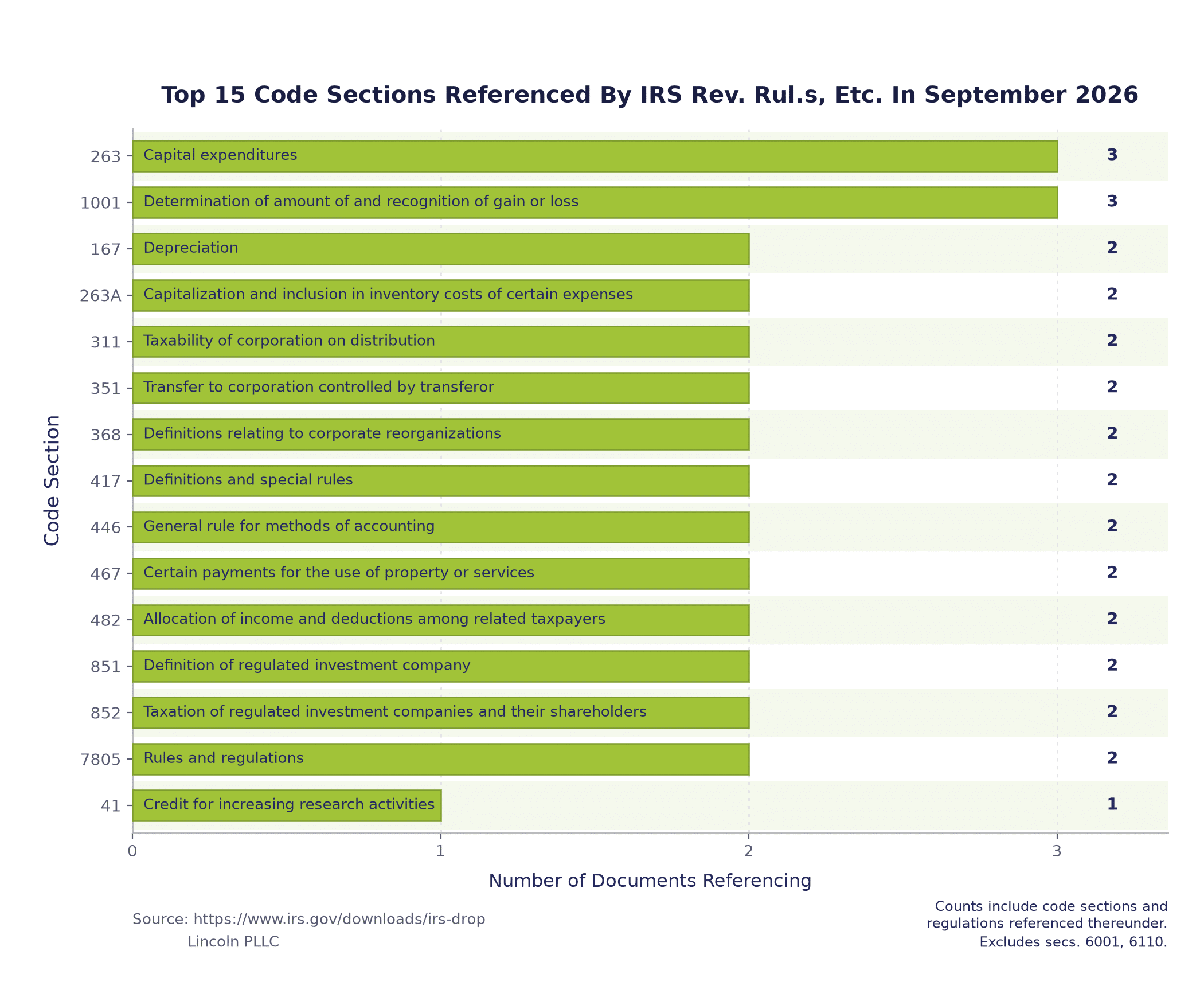
Document Summaries (13 documents)
Revenue Rulings (2)
Rev. Rul. 2026-19 (Sept. 18, 2026)Code sections referenced: § 42, § 280G, § 382, § 467, § 468, § 482, § 483, § 1274, § 1288, § 7520, § 7702, § 7872
Rev. Rul. 2026-19 is a monthly prescribed-rates revenue ruling that sets the applicable federal rates and related percentages for federal income tax purposes for October 2026. The ruling establishes the short-term, mid-term, and long-term AFRs (4.25%, 4.61%, and 5.22% annual, respectively), the adjusted AFRs, the adjusted federal long-term rate and long-term tax-exempt rate under section 382 (both 3.95%), the low-income housing credit percentages under section 42(b)(1) (8.15% for the 70% present value credit and 3.49% for the 30% present value credit), and the section 7520 rate (5.60%). The ruling relies on sections 42, 280G, 382, 467, 468, 482, 483, 1274, 1288, 7520, 7702, and 7872 of the Internal Revenue Code.
Rev. Rul. 2026-20 (Sept. 28, 2026)Code sections referenced: § 311, § 351, § 368, § 851, § 852, § 1001
Rev. Rul. 2026-20 is a revenue ruling addressing whether a transfer of appreciated securities by an investor to a newly formed ETF that is intended to qualify as a § 351 exchange fails to so qualify when, as part of the same plan, the ETF redeems shares held by an authorized participant using those same contributed securities in a transaction intended to qualify under § 852(b)(6). Applying the substance-over-form and step-transaction doctrines, the IRS held that the transfer is recharacterized to reflect its substance, such that Investor is treated as undertaking a taxable exchange under § 1001 with the authorized participant of the securities contributed to ETF by Investor that are used by ETF to redeem the authorized participant. The ruling relies principally on §§ 351, 852(b)(6), and 1001, as well as Reg. § 1.351-1, and draws on authorities including Portland Oil Co. v. Commissioner, 109 F.2d 479 (1st Cir. 1940), Minnesota Tea Co. v. Helvering, 302 U.S. 609 (1938), Commissioner v. Court Holding Co., 324 U.S. 331 (1945), Kuper v. Commissioner, 533 F.2d 152 (5th Cir. 1976), Waterman Steamship Corp. v. Commissioner, 430 F.2d 1185 (5th Cir. 1970), and Rev. Rul. 75-360; it amplifies Rev. Rul. 71-336 and distinguishes Rev. Rul. 75-447 and Rev. Rul. 88-32.
Revenue Procedures (1)
Rev. Proc. 2026-32 (Sept. 4, 2026)Code sections referenced: § 41, § 167, § 174, § 174A, § 263, § 263A, § 446, § 448, § 460, § 481, § 611
Rev. Proc. 2026-32 is a revenue procedure that modifies sections 7 and 19 of Rev. Proc. 2025-23 to update the automatic consent procedures for two categories of accounting method changes made necessary by the One Big Beautiful Bill Act: (1) changes in the treatment of domestic and foreign research or experimental expenditures under TCJA § 174, § 174, and new § 174A, and (2) changes in the treatment of residential construction contracts under § 460(e), as amended by the OBBBA. The IRS concludes that taxpayers may obtain automatic consent to change their accounting methods for these items by filing Form 3115, with modifications to the § 481(a) adjustment rules for certain concurrent or sequential research expenditure method changes, an extension of eligibility-rule waivers through taxable years beginning before 2028, removal of the prior limitation restricting foreign research expenditure changes to years beginning before January 1, 2026, and addition of new automatic change number 275 covering residential construction contracts entered into in taxable years beginning after July 4, 2025. The principal authorities relied on are §§ 174, 174A, 446, 446(e), 460, 460(e), 481, and 263A of the Code, together with Treas. Reg. §§ 1.446-1 and 1.460-4.
Notices (10)
Notice 2026-53 (Sept. 8, 2026)Code sections referenced: § 45V, § 45Z
Notice 2026-53 is an IRS notice addressing the establishment of emissions rates under § 45Z(b)(1)(B) for the clean fuel production credit, specifically covering transportation fuels derived from animal manure, the treatment of regenerative agricultural feedstock practices, and transition guidance for applying amendments to § 45Z enacted by § 70521 of the One, Big, Beautiful Bill Act. The notice concludes that distinct emissions rates based on specific animal manure feedstocks (dairy and swine manure, with poultry and beef manure anticipated) apply to transportation fuel produced after December 31, 2025; that taxpayers may use the 2026 version of 45ZCF FD-CIC for fuel produced in 2025 and 2026 subject to USDA technical guidelines with a safe harbor for the pre-application nutrient budget requirement; and that taxpayers using pre-June 2026 model versions must manually adjust their results to exclude ILUC emissions, eliminate negative emissions rates (except for animal manure fuels), and disallow non-Canadian/Mexican feedstocks for fuel produced after December 31, 2025. The notice relies principally on §§ 45Z(a)(1), 45Z(b)(1)(A)–(E), 45Z(b)(2), 45Z(d)(1)–(3), 45Z(d)(5)(A), 45Z(f)(1)(A)(iii), and § 1.45V-4(f), as amended by § 70521 of Public Law 119-21.
Notice 2026-54 (Sept. 15, 2026)Code sections referenced: § 1033
Notice 2026-54 is an IRS notice addressing whether taxpayers who sold livestock on account of drought and whose four-year replacement period under § 1033(e)(2)(A) is scheduled to expire at the end of 2026 qualify for an extension of that replacement period. The IRS concludes that taxpayers whose applicable region includes any county on the appended list—which identifies areas experiencing exceptional, extreme, or severe drought during the 12-month period ending August 31, 2026—are entitled to an extension of their replacement period, which will continue until the end of the taxpayer's first taxable year ending after a drought-free year for the applicable region as defined in Notice 2006-82. The notice relies on §§ 1033(a) and 1033(e)(1) and (2), and incorporates the framework established by Notice 2006-82, 2006-2 C.B. 529.
Notice 2026-57 (Sept. 17, 2026)Code sections referenced: § 412, § 414, § 417, § 430, § 431, § 433
Notice 2026-57 is an IRS notice providing updated yield curve and interest rate figures used to determine pension plan funding obligations, addressing the corporate bond monthly yield curve, 24-month average segment rates, minimum present value segment rates, and the 30-year Treasury weighted average rate applicable for September 2026 plan years. The notice publishes the August 2026 monthly corporate bond yield curve, spot segment rates of 4.65, 5.75, and 6.73 for the first, second, and third segments respectively, adjusted 24-month average segment rates for plan years beginning in 2025, 2026, and 2027 (with the first segment floored at 4.75 in each case), and a 30-year Treasury weighted average rate of 4.63 percent with a permissible range of 4.16 to 4.86 percent for plan years beginning in September 2026. The notice relies on §§ 412, 414(y), 417(e)(3), 417(e)(3)(A)(ii)(II), 417(e)(3)(D), 430(h)(2), 430(h)(2)(C)(i)–(iv), 430(h)(2)(D)(ii), 431(c)(6)(A), 431(c)(6)(B), 431(c)(6)(E)(ii)(I), 433(c)(7)(C), and 433(h)(3)(A), as well as Treas. Reg. §§ 1.417(e)-1(d)(3) and 1.430(h)(2)-1(c) and (d), and Notice 88-73.
Notice 2026-61 (Sept. 21, 2026)Code sections referenced: § 871, § 881, § 1001, § 1441, § 1461, § 1473
Notice 2026-61 is an IRS notice issued by the Treasury Department and the IRS addressing how taxpayers and withholding agents must comply with the dividend equivalent withholding rules during 2027, 2028, and 2029 while permanent regulatory amendments are pending. The notice extends by two years the transition relief previously provided in Notice 2024-44, continuing the good-faith enforcement standard for delta-one transactions through 2028 and for non-delta-one transactions through 2029, maintaining the simplified combined-transaction standard through 2028, exempting qualified derivatives dealers from tax and withholding on dividends and dividend equivalents received in their equity derivatives dealer capacity through 2028, deferring the net delta exposure computation requirement through 2028, relieving QDDs of periodic review obligations for 2027 and 2028, and permitting withholding agents to apply the qualified securities lender transition rules of Notice 2010-46, Parts C, D, and E, for payments made in 2027 and 2028. The notice relies on Code sections 871(m), 871(a), 881, 881(a)(1), 1441, 1461, and 1473, together with the regulations thereunder, including Treas. Reg. §§ 1.871-15, 1.1441-1(b)(4)(xxii), and 1.1441-1(e)(3)(ii)(E), and the 2023 QI Agreement issued under Rev. Proc. 2022-43.
Notice 2026-55 (Sept. 22, 2026)Code sections referenced: § 45D, § 1397C, § 1400Z, § 1445, § 1446, § 6039K, § 6039L, § 7805
Notice 2026-55 is a Treasury and IRS request for public comments addressing outstanding implementation questions under § 1400Z-2 as amended by § 70421 of the One Big Beautiful Bill Act, covering topics including interim-gain deferral for QOFs selling single-family housing inventory, working capital safe harbor modifications, the 10-year election and 30-year fair market value basis rule for post-2026 investments, inclusion event rules, and Opportunity Zone investment in Tribal and Alaska Native communities. The notice reaches no substantive legal conclusion but identifies specific legal and administrative questions on which guidance may be needed, including whether statutory authority exists under § 1400Z-2(e)(4) or § 7805(a) to defer gain recognition when a QOF reinvests proceeds from housing inventory sales. The authorities cited are § 1400Z-2 (including subsections (b), (c), (d), (e)(4)), § 1400Z-1, § 1397C(b)(8) and (e), § 45D, §§ 1445, 1446(a), 1446(f), §§ 6039K and 6039L, § 7805(a), and the existing regulations at §§ 1.1400Z2(a)-1 through 1.1400Z2(f)-1.
Notice 2026-52 (Sept. 24, 2026)Code sections referenced: § 4475, § 6656
Notice 2026-52 is an IRS notice extending penalty deposit relief previously granted in Notice 2025-55 to remittance transfer providers subject to the excise tax on certain remittance transfers, addressing when the failure-to-deposit penalty and deposit safe harbor rules apply during the period before final regulations take effect. A remittance transfer provider will be deemed to have satisfied the reasonable cause standard under section 6656—and its ability to use the deposit safe harbor will be preserved—for any semimonthly period ending before the applicability date of final regulations issued under section 4475, so long as the provider makes timely deposits (even if computed incorrectly) and pays any quarterly underpayment in full by the Form 720 due date. The notice relies on sections 4475 and 6656 of the Code and § 40.6302(c)-1(b)(2) of the Excise Tax Procedural Regulations in 26 CFR part 40.
Notice 2026-60 (Sept. 24, 2026)Code sections referenced: § 274
Notice 2026-60 is an annual IRS notice addressing the special per diem rates taxpayers may use to substantiate ordinary and necessary business travel expenses away from home for the period beginning October 1, 2026. The notice sets the transportation industry M&IE rates at $80 (CONUS) and $86 (OCONUS), the incidental-expenses-only rate at $5 per day, and the high-low substantiation rates at $329 (high-cost localities) and $230 (all other CONUS localities), with meals portions of $86 and $74 respectively, and updates the list of high-cost localities by adding Tucson, San Mateo/Foster City/Belmont, Albuquerque, and Cody, removing Panama City, and modifying the applicable periods for fifteen other localities. The notice relies on § 274(d) of the Internal Revenue Code, § 1.274-5 of the Income Tax Regulations, and Rev. Proc. 2019-48, and supersedes Notice 2025-54.
Notice 2026-62 (Sept. 28, 2026)Code sections referenced: § 263, § 302, § 311, § 317, § 351, § 368, § 446, § 475, § 512, § 721, § 851, § 852, § 957, § 988, § 1001, § 1012, § 1092, § 1234A, § 1256, § 7805
Notice 2026-62 is an IRS and Treasury Department notice identifying several novel, potentially abusive investment fund strategies that exploit §852(b)(6)'s nonrecognition rule for ETF in-kind redemptions, including so-called §351 conversion transactions, partnership exchange fund variations, box spread funds, record-date dividend-avoidance strategies, RIC income-test circumvention schemes, and tax-aware fund strategies that manufacture ordinary losses paired with capital gains through identified straddles, selective §988(a)(1)(B) elections, and selective NPC terminations. The IRS and Treasury have not yet reached a definitive holding on most of the described transactions but announce that Rev. Rul. 2026-20 is being issued concurrently to recharacterize certain §351 conversion transactions as taxable exchanges under §1001, signal that the remaining strategies are inconsistent with existing law and may be challenged on examination or addressed through forthcoming guidance (potentially including listed or transaction-of-interest designations), and request public comments by October 28, 2026. The notice principally relies on §§311(a) and (b), 317(a), 351(a) and (e), 721(a) and (b), 851(b)(2), 852(b)(6), 988(a)(1)(A) and (B), 1001(a) and (c), 1012(a), 1092(a)(1), (a)(2), and (c)(1), 1234A, 1256(a)(3) and (c)(1), 1.351-1(c)(1), (5), and (6), 1.446-3(e), (f), and (h), 7805(b)(1) and (b)(3), and §368(a)(2)(F)(ii), as well as the anti-abuse authority and judicial doctrines referenced throughout.
Notice 2026-58 (Sept. 29, 2026)Code sections referenced: § 54, § 54B, § 54C, § 54F, § 119, § 162, § 167, § 179, § 198, § 263, § 263A, § 280F, § 409, § 411, § 417, § 467, § 469, § 482, § 752, § 809, § 831, § 846, § 860G, § 1232, § 1272, § 1400, § 1400B, § 2012, § 2032, § 2053, § 2056A, § 2511, § 3402, § 4995, § 6011, § 6041, § 6045, § 6045A, § 6045B, § 6050W, § 6111, § 6166, § 6166A, § 6695, § 6721, § 6722, § 7701
Notice 2026-58 is an IRS administrative notice addressing which previously published Internal Revenue Bulletin guidance documents have become extraneous and should be formally retired. The Treasury Department and IRS conclude that 71 revenue rulings, revenue procedures, notices, and announcements are obsolete—because their underlying Code sections were repealed or amended, the subject matter is now covered by final regulations, the guidance applied only to closed time periods, comments solicited were fully addressed, or the guidance expired by its own terms—and formally obsolete each of the 71 documents. The notice is issued pursuant to Executive Order 14192 and Executive Order 14219, and the obsoleted items variously implicate Code sections including 54, 54B, 54C, 54F, 162, 167, 198, 263, 263A, 409(p), 411(a), 411(a)(13), 411(b)(5), 417(e), 467, 469(c), 752, 809, 846, 860G(d), 1232, 1272, 1400, 1400B, 2032, 2053, 2056A, 3402(q), 4995, 6041, 6045, 6045A, 6045B, 6045(f), 6045(g), 6045(h), 6050W, 6111, 6166, 6695(b), 6721, and 6722.
Notice 2026-63 (Sept. 30, 2026)Code sections referenced: § 692, § 7508A
Notice 2026-63 is an IRS administrative notice addressing the postponement of tax deadlines for taxpayers affected by the ongoing terroristic action in the State of Israel throughout 2025 and 2026. The Secretary of the Treasury determined on September 30, 2026, that the terrorist activity against Israel constitutes a terroristic action under section 692(c)(2), and accordingly all covered taxpayer acts and government acts otherwise due on or after September 30, 2026, and before September 30, 2027, are postponed until September 30, 2027, with acts previously postponed under Notices 2023-71, 2024-72, and 2025-53 further extended to that same date for eligible taxpayers. The notice relies principally on sections 7508A and 692(c)(2) of the Code, Treas. Reg. § 301.7508A-1, Revenue Procedure 2004-26, and Revenue Procedure 2018-58.
In September 2026, the IRS published 28 PLRs and 1 CCA, which included a total of 180 pages.
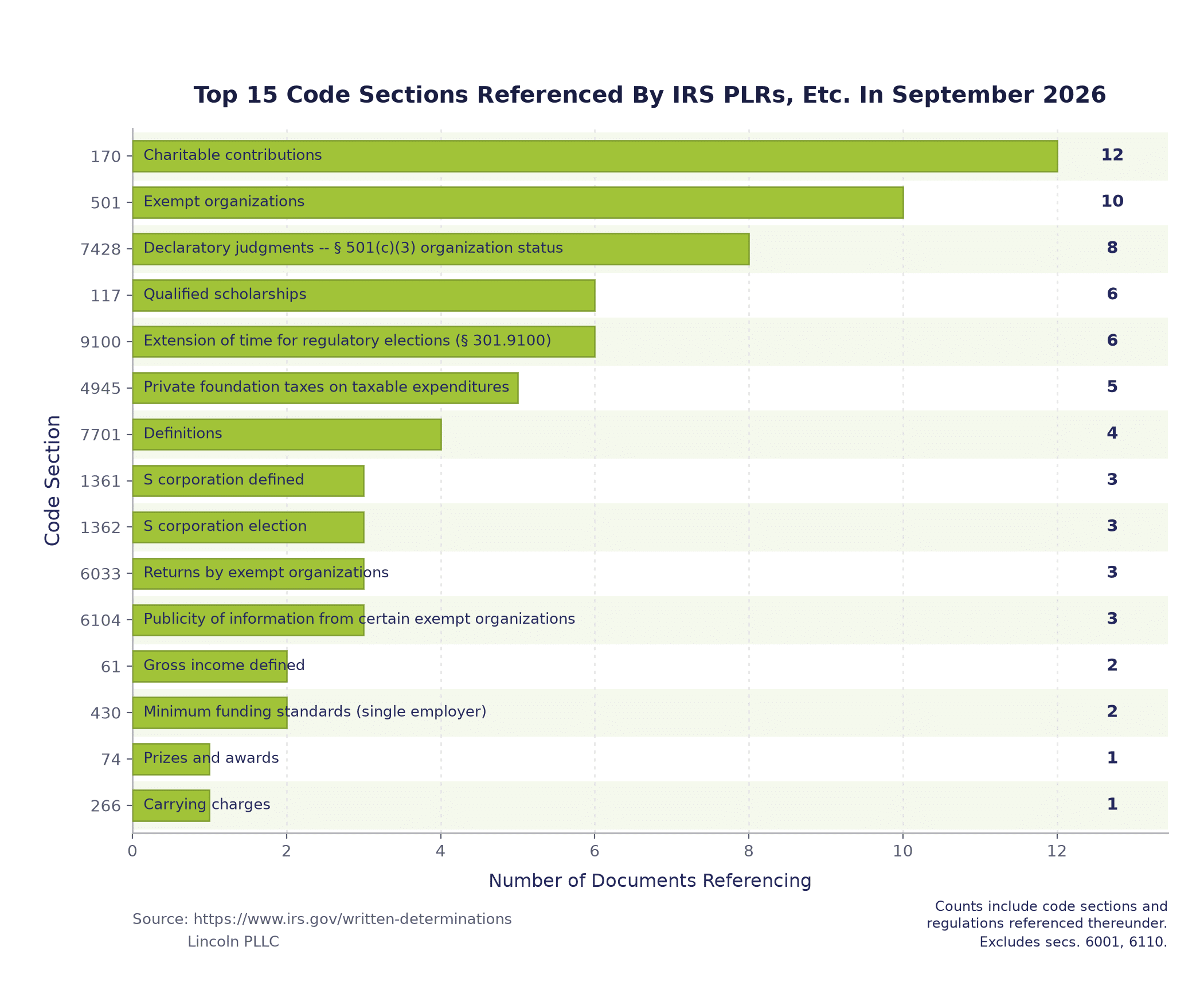
Document Summaries (29 documents)
Private Letter Rulings — § 9100 Relief (6)
Priv. Ltr. Rul. 2026-37-001 (Sept. 11, 2026)Code sections referenced: § 734, § 743, § 754, § 6031, § 6227, § 9100
Private Letter Ruling 202637001 is a ruling responding to a request by X, a limited liability company treated as a partnership for federal tax purposes, for an extension of time to file a § 754 election that X intended to make for its Year taxable year but inadvertently failed to file with its timely partnership return. The IRS concluded that X satisfied the reasonable-and-good-faith and no-government-prejudice requirements and granted X a 120-day extension from the date of the letter to make the § 754 election, conditioned on X filing amended returns reflecting all § 734(b) and § 743(b) basis adjustments that would have been made had the election been timely filed, partners adjusting their outside bases accordingly, and X complying with § 6227(b) if an administrative adjustment request is required. The ruling relies on §§ 754, 734, 743, and 6227(b) of the Code, and §§ 301.9100-1, 301.9100-3, and 1.754-1(b) of the regulations.
Priv. Ltr. Rul. 2026-37-003 (Sept. 11, 2026)Code sections referenced: § 7701, § 9100
Private Letter Ruling 202637003 addresses a request by eight limited liability companies (S, T, U, V, W, X, Y, and Z), each organized under the laws of State on Date, for an extension of time to file Form 8832 electing association-taxable-as-corporation status for federal tax purposes after each Entity missed the timely filing deadline. The IRS granted each Entity a 120-day extension from the date of the letter to file a properly executed Form 8832 effective Date, concluding that the Entities acted reasonably and in good faith and that granting relief would not prejudice the government's interests. The ruling relies on Treas. Reg. §§ 301.7701-2, 301.7701-3(a), (b)(1), and (c)(1)(i) and (iii), and §§ 301.9100-1, 301.9100-2, and 301.9100-3.
Priv. Ltr. Rul. 2026-37-004 (Sept. 11, 2026)Code sections referenced: § 7701, § 9100
Private Letter Ruling 202637004 is a ruling responding to a request by X, a limited liability company organized under the laws of State, for an extension of time to file Form 8832 to elect treatment as an association taxable as a corporation for federal tax purposes, after X, which intended the election to be effective Date, failed to timely file that form. The IRS concluded that X satisfied the requirements of § 301.9100-3 by demonstrating it acted reasonably and in good faith and that granting relief would not prejudice the government's interests, and accordingly granted X a 120-day extension from the date of the letter to file a properly executed Form 8832. The ruling relies on §§ 301.7701-2, 301.7701-3(a), (b)(1), and (c)(1)(i) and (iii), and §§ 301.9100-1, 301.9100-2, and 301.9100-3 of the Procedure and Administration Regulations, as well as § 6110(k)(3) of the Code.
Priv. Ltr. Rul. 2026-37-007 (Sept. 11, 2026)Code sections referenced: § 266, § 1012, § 1016, § 6501, § 6662, § 6664, § 9100
Private Letter Ruling 202637007 is a ruling responding to Taxpayer 1 and Taxpayer 2's request for an extension of time to elect to capitalize carrying costs under § 266 for Years 1–2 and the portion of Year 3 through Date 1, after their paid preparers failed to make the election on their originally filed returns. The IRS concluded that Taxpayers acted reasonably and in good faith and that granting relief would not prejudice the interests of the government, and accordingly granted a 60-day extension from the date of the ruling to file the capitalization statement required by § 1.266-1(c)(3). The ruling relies on §§ 266, 1.266-1(a)(1), 1.266-1(b)(1), 1.266-1(c)(1)–(3), 301.9100-1, 301.9100-3, 6501(a), 6662, and 6110(k)(3).
Priv. Ltr. Rul. 2026-38-001 (Sept. 18, 2026)Code sections referenced: § 1361, § 1362, § 7701, § 9100
Private Letter Ruling 202638001 addresses whether X, an LLC that inadvertently failed to timely file both a Form 8832 entity classification election and a Form 2553 S corporation election, and that also failed to timely file Form 8869 QSub elections for its wholly owned subsidiaries Y and Z, may receive extensions of time to make those elections. The IRS concluded that X acted reasonably and in good faith and granted X 120 days from the date of the ruling to file Form 8832 electing association status effective Date 4, Form 2553 electing S corporation status effective Date 4, and Forms 8869 electing QSub treatment for Y and Z effective Date 6. The ruling relies on Code sections 1361(a)(1), 1361(b)(1), 1361(b)(3), 1362(b)(1), 1362(b)(3), and 1362(b)(5), together with Regulations sections 1.1361-3(a), 301.7701-3(a), (b)(1), (c)(1)(i), (c)(1)(iii), and (c)(1)(v)(C), and 301.9100-1 and 301.9100-3.
Priv. Ltr. Rul. 2026-39-001 (Sept. 25, 2026)Code sections referenced: § 965, § 7701, § 9100
Private Letter Ruling 202639001 addresses a request by X, a foreign entity formed under the laws of Country on Date 1, for an extension of time to file Form 8832 electing partnership classification for federal tax purposes effective Date 2, after X failed to make that filing on a timely basis. The IRS concluded that X satisfied the reasonable-and-good-faith standard and granted a 120-day extension from the date of the ruling letter to file Form 8832, contingent on X and all U.S. owners filing all required federal income tax and information returns for open years consistent with the requested relief. The ruling relies on Treas. Reg. §§ 301.7701-2, 301.7701-3, 301.9100-1, 301.9100-2, 301.9100-3, and I.R.C. §§ 965 and 6110(k)(3).
Private Letter Rulings — Other (22)
Priv. Ltr. Rul. 2026-36-022 (Sept. 4, 2026)Code sections referenced: § 117, § 170, § 4945
Private Letter Ruling 202636022 is an advance approval letter addressing whether a private foundation's scholarship procedures for third- and fourth-year medical students demonstrating financial need at qualifying institutions in State B satisfy the requirements for non-taxable grants to individuals. The IRS approved the foundation's scholarship procedures, concluding that grants made under those procedures will not constitute taxable expenditures and that awards used for qualified tuition and related expenses will not be taxable to recipients. The ruling relies on IRC Sections 4945, 4945(d)(3), 4945(g), 4945(g)(1), 117(a), 117(b), 170(b)(1)(A)(ii), 170(c)(2)(B), and 6110.
Priv. Ltr. Rul. 2026-37-002 (Sept. 11, 2026)Code sections referenced: § 170, § 1361, § 1362
Private Letter Ruling 202637002 addresses whether X's S corporation election, which was ineffective due to a missing shareholder consent from B (a deemed owner of Trust 1), and a subsequent deemed termination caused by the trustee of Trust 2 failing to timely file an electing small business trust election, qualify for inadvertent ineffectiveness or termination relief. The IRS concluded that both failures were inadvertent within the meaning of § 1362(f) and ruled that X will be treated as an S corporation from Date 2 until Date 4, conditioned on B filing a written consent to the election within 120 days, the trustee of Trust 2 filing an ESBT election effective Date 3 within 120 days, and X's shareholders (including A, B, and Trust 2) and the beneficiaries of Trust 2 filing original or amended returns for all open years reflecting consistent S corporation treatment. The ruling relies on §§ 1361(a)(1), 1361(b)(1), 1361(c)(2)(A)(i), 1361(c)(2)(A)(v), 1361(e), 1361(e)(3), 1362(a), 1362(a)(2), 1362(d)(2), and 1362(f), together with Treas. Reg. §§ 1.1362-6(a)(2)(i), 1.1362-6(b)(2)(iv), 1.1361-1(m)(2)(i), 1.1361-1(m)(2)(iii), and 1.1361-1(j)(6)(iii).
Priv. Ltr. Rul. 2026-37-005 (Sept. 11, 2026)Code sections referenced: § 170, § 1361, § 1362
Private Letter Ruling 202637005 addresses whether X's S corporation election termination was inadvertent under § 1362(f) after Trust 2, which received shares from a grantor trust following the death of shareholder A, failed to file a timely electing small business trust election under § 1361(e)(3), rendering Trust 2 an impermissible shareholder and terminating X's S status on Date 4. The IRS concluded that the termination was inadvertent and ruled that X will be treated as a continuing S corporation from Date 4 forward, contingent on the trustee of Trust 2 filing an ESBT election effective Date 4, Trust 2 and its beneficiaries filing amended federal income tax returns for all open years within 120 days of the ruling, and X remitting a payment of $n within 45 days as an adjustment under § 1362(f)(4). The ruling relies on Code §§ 1361(a)(1), 1361(b)(1), 1361(c)(2)(A)(ii) and (v), 1361(e)(1)(A), 1361(e)(3), 1362(a), 1362(d)(2)(A), and 1362(f), together with Treasury Regulations §§ 1.1361-1(m)(2)(i), 1.1361-1(m)(2)(iii), and 1.1362-4(d).
Priv. Ltr. Rul. 2026-37-006 (Sept. 11, 2026)Code sections referenced: § 61, § 1001, § 1011, § 2001, § 2501, § 2511, § 2512, § 2601, § 2611, § 2631
Private Letter Ruling 202637006 (June 11, 2026) is a ruling responding to a request concerning the income, gift, and generation-skipping transfer tax consequences of a state court's judicial reformation of an irrevocable trust to correct a scrivener's error by adding Son's stepchild, A, and A's descendants to the class of trust beneficiaries defined as descendants of Settlor 1 and Settlor 2. The IRS ruled that the reformation will not cause Trust to lose its GST-exempt status under § 2601, will not cause any beneficiary to be treated as making a taxable gift of any portion of Trust, and will not constitute a realization event giving rise to gain or loss under § 1001 or taxable income under § 61, because the amendment corrects a drafting error and leaves beneficiaries' interests unchanged from Settlors' original intent. The ruling relies on Code §§ 61(a)(3), 1001(a)–(c), 1011, 2501, 2511(a), 2512(a) and (b), 2601, 2611, 2631, and 6110(k)(3); Treas. Reg. §§ 25.2511-1(c), 26.2601-1(b)(1)(i), 26.2601-1(b)(4)(i), and 26.2601-1(b)(4)(i)(C); § 1433 and § 1433(b)(2)(A) of the Tax Reform Act of 1986; and Commissioner v. Estate of Bosch, 387 U.S. 456 (1967), and Cottage Savings Ass'n v. Commissioner, 499 U.S. 554 (1991).
Priv. Ltr. Rul. 2026-37-009 (Sept. 11, 2026)Code sections referenced: § 61, § 501, § 511, § 6033, § 6361, § 7428
Private Letter Ruling 202637009 is a final adverse determination letter, supported by a Form 886-A audit report, addressing whether a dissolved Section 501(c)(3) organization's tax-exempt status should be revoked for failing the organizational and operational tests, specifically by distributing assets upon dissolution to an individual rather than to a qualifying exempt organization or governmental unit, ceasing all exempt-purpose activity after its last active semester of classes, and failing to produce adequate books and records during examination. The IRS concluded that the organization's exempt status should be revoked because the dissolution distribution to an individual directly contradicted both its own governing instrument's dissolution clause and the asset-dedication requirement, the organization conducted no exempt-purpose activities after a redacted date, and the organization failed to substantiate its expenditures and respond fully to multiple information document requests despite extensions and a delinquency notice; the IRS further determined that Form 1120 should be filed for tax periods after a redacted date. The authorities relied upon are IRC Sections 501(a), 501(c)(3), 6001, 6033(a)(1), and 7428; Treasury Regulations Sections 1.501(c)(3)-1, 1.501(c)(3)-1(a)(1), 1.501(c)(3)-1(b)(4), 1.501(c)(3)-1(c)(1), 1.501(c)(3)-1(c)(2), 1.6001-1(a), 1.6001-1(c), 1.6001-1(e), 1.6033-1(h)(2), and 1.61-1; and Rev. Rul. 59-95, 1959-1 C.B. 627.
Priv. Ltr. Rul. 2026-37-010 (Sept. 11, 2026)Code sections referenced: § 170, § 501, § 509, § 7428
Private Letter Ruling 202637010 is a final adverse determination letter, supported by an accompanying Form 886-A audit report, addressing whether an Organization that raised funds to repair or replace a privately owned and access-restricted property used exclusively by residents of a specific community continues to qualify for federal income tax exemption under IRC Section 501(c)(3). The IRS concluded that the Organization's exempt status must be revoked because its activities served the private interests of a defined group of community residents rather than a public interest, failing the operational test for exemption, and the Organization itself acknowledged that the property was not open to the public and that its fundraising benefited only those residents. The determination relies on IRC Sections 501(a), 501(c)(3), and 509(a)(1); Treasury Regulations Sections 1.501(c)(3)-1(a)(1), 1.501(c)(3)-1(c)(1), and 1.501(c)(3)-1(d)(1)(i) and (ii); and cites Columbia Park and Recreation Ass'n, Inc. v. Commissioner, 88 T.C. 1 (1987), Wendy Parker Rehabilitation EO, Inc. v. Commissioner, T.C. Memo 1986-348, Rev. Rul. 69-175, 1969-1 C.B. 149, and Rev. Rul. 71-395, 1971-2 C.B. 228.
Priv. Ltr. Rul. 2026-37-011 (Sept. 11, 2026)Code sections referenced: § 1501, § 1502, § 1504
Private Letter Ruling 202637011 addresses a determination-letter request by Parent and its wholly owned subsidiary Sub 1 as to whether Sub 1 should be treated as having consented to join in the filing of a consolidated return with Parent for the taxable year ending on Date 2, notwithstanding Sub 1's failure to file Form 1122 and the affiliated group's inability to qualify for automatic relief under Rev. Proc. 2014-24. The IRS determined that, under the facts and representations submitted, Sub 1 shall be treated as if it had filed Form 1122 for the taxable year ending on Date 2, and the Parent Affiliated Group shall be treated as satisfying the requirements for filing a consolidated return for that year. The ruling relies on IRC sections 1501 and 1504(a), Treas. Reg. §§ 1.1502-75(a)(1), (b)(1), (b)(2), (b)(3), (d)(1), and (h)(2), and Rev. Proc. 2014-24.
Priv. Ltr. Rul. 2026-38-002 (Sept. 18, 2026)Code sections referenced: § 1295, § 1297
Private Letter Ruling 202638002 addresses a request by married U.S. taxpayers for the Commissioner's consent to make a retroactive qualified electing fund election under section 1295(b) with respect to their minority interest in FC, a foreign corporation that qualified as a passive foreign investment company, where the timely election was missed because their tax professional failed to identify FC as a PFIC. The IRS granted consent for Taxpayers to make the QEF election retroactive to Year 1, concluding that Taxpayers satisfied all requirements of Treas. Reg. § 1.1295-3(f)—including reasonable reliance on a qualified tax professional, no prejudice to the government, no prior audit raise of PFIC status, and compliance with procedural requirements—provided that Taxpayers comply with Treas. Reg. § 1.1295-3(g) for the time and manner of making the retroactive election. The ruling relies on Code sections 1295(a), 1295(b)(2), and 1297(a), and Treas. Reg. §§ 1.1295-3(f) and 1.1295-3(g).
Priv. Ltr. Rul. 2026-38-003 (Sept. 18, 2026)Code sections referenced: § 170, § 501, § 6104, § 7428
Private Letter Ruling 202638003 consists of a proposed adverse determination letter (Letter 4034, dated 05/08/2026) and a final adverse determination letter (Letter 4038, dated 06/30/2026) addressing whether an agricultural college fraternity that filed Form 1023-EZ qualifies for federal income tax exemption under IRC Section 501(c)(3) on the basis of educational purposes. The IRS concluded that the Organization fails the operational test because it devotes a substantial portion of its time and resources to social and recreational activities — including brotherhood events, social gatherings, and similar member-focused programming — that constitute substantial non-exempt purposes, and because its scholarships and academic programming do not render those social and recreational activities merely incidental to an exempt purpose. The determination rests on IRC Section 501(c)(3), Treasury Regulation Section 1.501(c)(3)-1(a)(1) and -1(c)(1), IRC Section 170, IRC Sections 6104(c) and 6110, IRC Section 7428(b)(2), Revenue Rulings 69-573, 77-366, and 77-430, and the cases Better Business Bureau v. United States, 326 U.S. 279 (1945), Minnesota Kingsmen Chess Association v. Commissioner, T.C. Memo 1983-495, and St. Louis Science Fiction Limited v. Commissioner, T.C. Memo 1985-162.
Priv. Ltr. Rul. 2026-39-002 (Sept. 25, 2026)Code sections referenced: § 501, § 503, § 7428
Private Letter Ruling 2026-39-002 is a proposed adverse determination letter (Letter 4034) addressing whether an organization incorporated to provide combat veterans with PTSD treatment through adventure therapy and supervised ayahuasca ceremonies qualifies for federal income tax exemption under IRC Section 501(c)(3). The IRS concluded that the organization does not qualify because its program generally requires participant use of ayahuasca — a Schedule I controlled substance under federal law — without proof of a federal exemption, rendering its activities illegal under U.S. law and therefore not exclusively in furtherance of an exempt purpose under the operational test, regardless of whether the ceremonies are conducted abroad. The ruling relies on IRC Section 501(c)(3), Treas. Reg. Sections 1.501(c)(3)-1(a)(1) and 1.501(c)(3)-1(c)(1), 21 U.S.C. Sections 812(c) and 841(a)(3), Rev. Rul. 71-460, Rev. Rul. 75-384, Rev. Rul. 80-278, Better Business Bureau of Washington, D.C., Inc. v. United States, 326 U.S. 279 (1945), Iowaska Church of Healing v. Werfel, 105 F.4th 402 (D.C. Cir. 2024), Pius XII Academy, Inc. v. Commissioner, T.C. Memo. 1982-97, La Verdad v. Commissioner, 82 T.C. 215 (1984), Ohio Disability Association v. Commissioner, T.C. Memo. 2009-261, and IRC Section 7428(b)(2).
Priv. Ltr. Rul. 2026-39-003 (Sept. 25, 2026)Code sections referenced: § 501, § 7428
Private Letter Ruling 2026-39-003 is a proposed adverse determination letter addressing whether a two-member nonprofit condominium association formed to maintain common areas and appurtenances of commercial-use parcels qualifies for federal income tax exemption under IRC Section 501(c)(12). The IRS concluded that the Organization does not qualify, because its routine property maintenance services — including snow removal, landscaping, parking lot repair, and lighting upkeep — are provided primarily for the personal benefit of its two owner-members and are not similar in nature to the public utility or mutual ditch and irrigation activities required of a "like organization" under Section 501(c)(12). The ruling relies on IRC Section 501(c)(12), IRC Section 7428(b)(2), Rev. Rul. 65-201, Rev. Rul. 67-265, Rev. Rul. 68-564, Rev. Rul. 83-170, Rev. Rul. 2002-54, and Lake Petersburg Association v. Commissioner, 33 T.C.M. (CCH) 259 (T.C. 1974).
Priv. Ltr. Rul. 2026-39-004 (Sept. 25, 2026)Code sections referenced: § 501, § 7428
Private Letter Ruling 2026-39-004 is a proposed adverse determination letter addressing whether an angel investor network that recruits accredited investors to identify, vet, and fund early-stage companies—and, in a revised submission, to mentor promising startups without direct investment—qualifies for exemption as a business league under IRC § 501(c)(6). The IRS concluded that the Organization fails each prong of the applicable six-factor test because its members share no common business interest beyond maximizing individual investment returns, its core activities (providing investment advice and startup mentorship) constitute a regular business of a kind ordinarily carried on for profit, its activities perform particular services for individual persons rather than improving business conditions across a line of business, it bears no resemblance to a chamber of commerce or board of trade, and its provision of free mentorship services to selected startup companies produces inurement to private individuals. The IRS relied on IRC § 501(c)(6), IRC § 7428(b)(2), Treas. Reg. § 1.501(c)(6)-1, Rev. Rul. 59-391, Rev. Rul. 70-641, Rev. Rul. 73-411, Crooks v. Kansas City Hay Dealers' Ass'n, 37 F.2d 83 (8th Cir. 1929), Northwestern Jobbers Credit Bureau v. Commissioner, 37 F.2d 880 (8th Cir. 1930), Produce Exchange Stock Clearing Ass'n v. Commissioner, 71 F.2d 142 (2d Cir. 1934), Retailers Credit Ass'n of Alameda County v. Commissioner, 90 F.2d 47 (9th Cir. 1937), Northwestern Municipal Ass'n, Inc. v. United States, 99 F.2d 460 (8th Cir. 1938), National Muffler Dealers Ass'n, Inc. v. United States, 440 U.S. 472 (1979), Engineers Club of San Francisco v. United States, 791 F.2d 686 (9th Cir. 1986), and Bluetooth SIG Inc. v. United States, 611 F.3d 617 (9th Cir. 2010).
Priv. Ltr. Rul. 2026-39-005 (Sept. 25, 2026)Code sections referenced: § 117, § 170, § 501, § 508, § 6104, § 7428
Private Letter Ruling 202639005 is a final adverse determination letter, accompanied by the underlying proposed adverse determination, addressing whether an LLC formed with two individual members—one of whom serves as fellowship director—qualifies for exemption from federal income tax as an organization described in IRC Section 501(c)(3), based on its operation of a medical fellowship program. The IRS concluded that the organization fails both the organizational test, because its members are individuals rather than Section 501(c)(3) organizations or governmental units as required by Notice 2021-56, and the operational test, because the fellowship substantially furthers the private interests of D, the controlling member, and the fellowship stipend is compensatory in nature rather than a qualifying educational grant, with those non-exempt purposes being more than insubstantial. The authorities relied on are IRC Sections 501(a), 501(c)(3), 170(c)(1), 508(e)(1), 117, 6104(c), 6110, and 7428(b)(2); Treasury Regulation Sections 1.117-4(c)(1), 1.501(c)(3)-1(a)(1), (b)(1), (b)(4), (c)(1), and (d)(1)(ii) and (d)(3)(i); Notice 2021-56; and the cases Better Business Bureau of Washington, D.C., Inc. v. United States, 326 U.S. 279 (1945); Miss Georgia Scholarship Fund, Inc. v. Commissioner, 72 T.C. 267 (1979); Retired Teachers Legal Defense Fund, Inc. v. Commissioner, 78 T.C. 280 (1982); Local Union 712, I.B.E.W. Scholarship Trust Fund v. C.I.R., T.C. Memo. 1983-76 (1983); and American Campaign Academy v. Commissioner, 92 T.C. 1053 (1989).
Priv. Ltr. Rul. 2026-39-006 (Sept. 25, 2026)Code sections referenced: § 170, § 501, § 6104, § 7428
Private Letter Ruling 202639006 is a final adverse determination letter, accompanied by the underlying proposed adverse determination, addressing whether an organization that operates a bi-weekly farmers market qualifies for federal income tax exemption under IRC Section 501(c)(3). The IRS concluded that the organization fails the operational test because its primary activity—operating the farmers market—substantially furthers the private interests of its vendors rather than a public exempt purpose, and because its educational and charitable activities (nutrition education, food access outreach, and SNAP/EBT programming) are incidental to that primary commercial purpose and are conducted on a scale larger than reasonably necessary to accomplish any exempt objective. The determination relies on IRC Sections 501(a), 501(c)(3), and 7428(b)(2); Treasury Regulation Sections 1.501(c)(3)-1(a)(1), 1.501(c)(3)-1(c)(1), 1.501(c)(3)-1(d)(1)(ii), 1.501(c)(3)-1(d)(2), and 1.501(c)(3)-1(d)(3)(i); IRC Section 170 (charitable deduction); IRC Section 6104(c) (state notification); IRC Section 6110 (public inspection); and Revenue Rulings 67-216, 67-367, 69-175, 73-127, 73-128, and 75-286, as well as Better Business Bureau of Washington, D.C., Inc. v. United States, 326 U.S. 279 (1945).
Priv. Ltr. Rul. 2026-39-007 (Sept. 25, 2026)Code sections referenced: § 501, § 6033
Private Letter Ruling 202639007 addresses a redacted organization's request to be exempt from the requirement to file Form 990, Return of Organization Exempt from Income Tax. The IRS determined that the organization qualifies as an integrated auxiliary of a church and is therefore not required to file Form 990. The ruling relies on IRC Section 501(a), IRC Section 501(c)(3), IRC Section 6110, Treasury Regulation Section 1.6033-2(g)(1)(i), and Treasury Regulation Section 1.6033-2(h).
Priv. Ltr. Rul. 2026-39-008 (Sept. 25, 2026)Code sections referenced: § 74, § 117, § 170, § 4945
Private Letter Ruling 202639008 is an advance approval letter issued to a private foundation addressing whether its procedures for awarding educational grants to medical professionals training in a specified medical field (T) — through four programs providing research funding and international travel scholarships — satisfy the requirements of IRC Section 4945(g)(3). The IRS approved the foundation's grant procedures, concluding that grants awarded under those procedures will not constitute taxable expenditures because the selection process is objective and nondiscriminatory and the procedures are reasonably calculated to result in recipients performing the intended grant activities. The ruling relies on IRC Sections 4945, 4945(d)(3), 4945(g), 4945(g)(3), 117(a), 170(b)(1)(A)(i), 170(c)(2)(B), and 74(b), as well as Treasury Regulation Section 53.4945-4(c)(1).
Priv. Ltr. Rul. 2026-39-009 (Sept. 25, 2026)Code sections referenced: § 430
Private Letter Ruling 202639009 is a letter ruling issued by the IRS Tax Exempt and Government Entities Division addressing whether Taxpayer may use substitute mortality tables for Plan 2 in lieu of the standard mortality tables prescribed under section 430 of the Code, covering male and female combined annuitant and nonannuitant populations (including disabled participants) for up to five plan years beginning October 1, 2026. The IRS granted the request, determining that the substitute mortality tables—developed from an experience study period of October 1, 2019 through September 30, 2024, with a base year of 2022, and applied on a generational basis using partial credibility weighting—were developed in accordance with the applicable regulations and Revenue Procedure 2024-32, with the specific mortality ratios and partial credibility weighting factors redacted from the released text. The ruling relies principally on section 430(h)(3)(A), (C), (C)(i), (C)(iii), and (D) of the Code, Treas. Reg. §§ 1.430(h)(3)-1 and 1.430(h)(3)-2 (including subsections (c)(2)–(3), (c)(6), (d)(2), (d)(4), and (e)(1)–(2)), section 6110(k)(3) of the Code, and Revenue Procedure 2024-32.
Priv. Ltr. Rul. 2026-39-010 (Sept. 25, 2026)Code sections referenced: § 430
Private Letter Ruling 202639010 is a letter ruling issued by the IRS Tax Exempt and Government Entities Division addressing whether Taxpayer's Plan 1 may use substitute mortality tables, developed from an experience study period of October 1, 2019 through September 30, 2024 (base year 2022), for minimum funding computations under section 430 in lieu of the standard prescribed tables. The IRS granted the request for both male and female combined annuitant and nonannuitant populations (including disabled participants) for up to five plan years beginning October 1, 2026, finding the tables were developed in accordance with applicable regulations and Revenue Procedure 2024-32, and noting that a minor error in Taxpayer's credibility weighting factor calculation had no significant effect on the proposed tables. The ruling relies principally on Code sections 430(h)(3)(A), 430(h)(3)(C), and 430(h)(3)(D), Treas. Reg. §§ 1.430(h)(3)-2(c)(3), (c)(4), (c)(6), (d)(2), (d)(3), and (d)(4), ERISA section 303(h)(3), Revenue Procedure 2024-32, and Code section 6110(k)(3).
Priv. Ltr. Rul. 2026-39-011 (Sept. 25, 2026)Code sections referenced: § 117, § 170, § 4945, § 4946
Private Letter Ruling 2026-39-011 is a Letter 4792 advance-approval ruling addressing whether a private foundation's scholarship program—awarding tiered grants to low-to-moderate-income college students pursuing a religious vocation in a specified geographic community—qualifies as a non-taxable expenditure under the rules governing individual grants by private foundations. The IRS concluded that the program meets all required conditions and approved the grant-making procedures in advance, meaning scholarships awarded under the described program will not constitute taxable expenditures. The ruling relies on IRC §§ 4945 (taxable expenditures of private foundations), 4945(g) (exception for approved scholarship and fellowship grants), 117(a) (exclusion of qualified scholarships from gross income), 170(b)(1)(A)(ii) (definition of qualifying educational organizations), 4946 (definition of disqualified persons), 4946(d) (family member definition), 170(c)(2)(B) (charitable purpose requirement), and 6110 (public inspection of written determinations).
Priv. Ltr. Rul. 2026-39-012 (Sept. 25, 2026)Code sections referenced: § 117, § 170, § 4945
A private foundation requested advance approval of its scholarship grant procedures under IRC Section 4945(g)(1) to fund higher education for qualifying students ranging from 7th grade through the fourth year of college, with awards varying in amount based on program cost, recipient matching ability, and prior award history. The IRS approved the foundation's procedures, determining that scholarships awarded under them will not constitute taxable expenditures by the foundation and will not be taxable to recipients when used for qualified tuition and related expenses. The ruling relies on IRC Sections 4945, 4945(d)(3), 4945(g), 4945(g)(1), 117(a), 117(b), 170(b)(1)(A)(ii), and 170(c)(2)(B).
Priv. Ltr. Rul. 2026-39-013 (Sept. 25, 2026)Code sections referenced: § 170, § 501, § 6033
Private Letter Ruling 202639013 is a letter ruling addressing whether Organization qualifies for an exemption from the requirement to file Form 990, Return of Organization Exempt from Income Tax. The IRS determined that Organization qualifies as a below-college-level educational organization of general academic nature affiliated with a church or operated by a religious order, and therefore is not required to file Form 990, though it must annually file Form 5578 to certify racial nondiscrimination compliance pursuant to Revenue Procedure 75-50. The ruling relies on IRC Section 170(b)(1)(A)(ii), IRC Section 501(c)(3), IRC Section 6110, Treasury Regulation Section 1.6033-2(g)(1)(vi), Treasury Regulation Section 1.6033-2(h)(2), and Revenue Procedure 75-50.
Priv. Ltr. Rul. 2026-39-014 (Sept. 25, 2026)Code sections referenced: § 117, § 170, § 4945
Private Letter Ruling 202639014 is an advance approval letter from the IRS addressing whether a private foundation's scholarship selection procedures satisfy the requirements for excluding grants to individuals from treatment as taxable expenditures under IRC Section 4945(g)(1). The IRS approved the foundation's procedures, determining that scholarships awarded on an objective and nondiscriminatory basis to students from seventh grade through fourth-year college, in amounts ranging between d dollars and e dollars, paid directly to educational institutions and selected by the board of trustees based on GPA, extracurricular involvement, and letters of recommendation, meet all requirements of Section 4945(g)(1) and therefore will not constitute taxable expenditures. The ruling relies on IRC Sections 4945, 4945(d)(3), 4945(g), 4945(g)(1), 117(a), 117(b), 170(b)(1)(A)(ii), and 170(c)(2)(B).
Chief Counsel Advice Memoranda (1)
Chief Couns. Adv. Mem. 2026-37-008 (Sept. 11, 2026)Code sections referenced: § 6103, § 7623
Chief Counsel Advice Memorandum 202637008 addresses whether, under section 6103, the return information of taxpayers not identified by or otherwise unknown to a whistleblower may be disclosed during the whistleblower's non-docketed review of the administrative claim file in a whistleblower administrative proceeding. The Office of Chief Counsel concludes that such disclosure is permissible if the proceeding arose out of, or in connection with, determining the unidentified taxpayers' civil or criminal liability, and the disclosure would not identify a confidential informant or seriously impair a tax investigation. The memorandum relies principally on sections 6103(h)(4)(A) and 7623(b), Treas. Reg. §§ 301.7623-3(c)(1), (c)(5), and (e)(2) and 301.6103(h)(4)-1, the Taxpayer First Act of 2019 (Pub. L. No. 116-25) as it bears on sections 6103(k)(6) and 6103(k)(13), and the Tax Court's decision in Whistleblower 972-17W, 159 T.C. 1 (2022).